

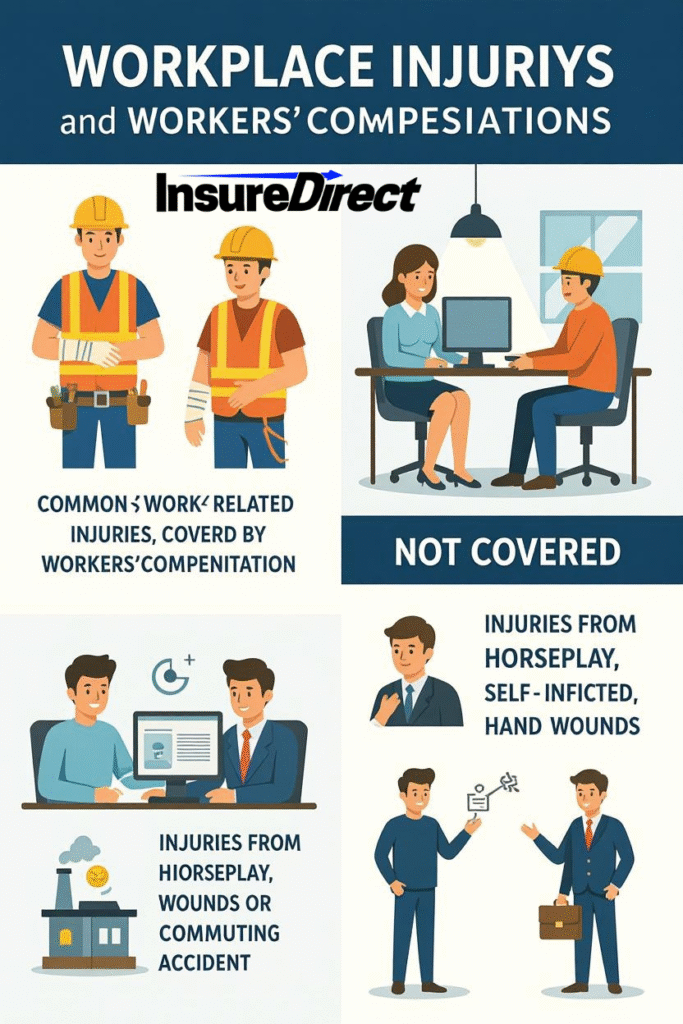
Here is what workers compensation covers: medical care, part of an injured worker’s lost wages, disability benefits, and death benefits when the job hurts or sickens an employee. It generally pays regardless of fault, so the question is whether the injury came from work.
Each state sets its own rules and benefit levels. Get a Workers Comp Quote for a price built around your business, or read on to see what is in and what is out.
What Workers Compensation Covers: The Four Core Benefits
Workers compensation helps an injured worker, or the worker’s family, in four ways:
- Medical care: all medically necessary and appropriate treatment for the injury.
- Wage replacement: a share of lost income while the worker cannot return to work. Some states cap the number of weeks, especially for temporary disability.
- Disability benefits: these depend on whether the disability is total or partial, and temporary or permanent.
- Death benefits: if a worker is killed on the job, benefits go to the worker’s dependents.
Myths About Workers Compensation Coverage
Myth: Workers comp pays an injured worker’s full salary. It replaces a portion of lost income, and some states limit how many weeks temporary benefits last.
Myth: If the employee made the mistake, there is no coverage. Workers comp generally pays regardless of fault, so a worker’s own error does not usually decide the claim. State exceptions exist.
Myth: Workers comp only covers dramatic accidents. It also reaches certain occupational illnesses and everyday injuries tied to the job. More mistaken beliefs are cleared up in workers compensation myths. The workers’ comp claim filing process shows how a claim moves once it is reported.
Which Injuries and Illnesses Count
Most states ask whether the injury happened in the course and scope of employment. A fall from a ladder at a job site, a back strain from lifting stock, and a cut from a machine all fit. Certain occupational illnesses can count too, and each state decides which conditions qualify. A normal commute is generally not part of the job, so commuting accidents are generally not covered.
Covered or Not? Everyday Examples
These examples show how the general rules usually apply. They are illustrations, and your state’s law and the facts of the injury decide the real answer.
| Situation | Generally covered? | Why |
|---|---|---|
| An employee falls from a ladder at a job site | Yes | The injury happened in the course of the job |
| An employee strains a back lifting stock | Yes | Everyday job injuries count, not only dramatic ones |
| An employee is in a crash on the normal drive to work | No | A normal commute is generally not part of the job |
| An employee is in a crash while driving to a customer | Often | Travel that is part of the job is often treated differently |
| A customer slips in your store | No | Customers are not employees, so this is a general liability claim |
| A worker for an uninsured subcontractor is hurt on your job | Often yes | Most states treat that worker as your employee |
What Workers Compensation Does Not Cover
Knowing the edges shows you what else to buy:
- Injuries to customers and visitors: people who are not your employees bring claims under general liability insurance.
- Business property damage: buildings and equipment belong under commercial property insurance.
- Professional mistakes: a client’s financial loss from your advice is an E&O matter, not a workers comp one.
- Some owners: in most states sole proprietors and partners are not required to buy coverage until they have employees, though they may opt in.
- Other excluded injuries: each state decides which injuries and conditions are covered, so check your state’s rules.
Who Must Carry Workers Compensation
Texas is the only state where workers comp is optional for most private employers. Elsewhere it depends on the state: many start at your first employee, others at a higher number, commonly three to five. Subcontractors count too. Most states treat an uninsured contractor, or that contractor’s employees, as your employees if they are hurt on your job, so ask for a certificate of insurance first. Read why workers compensation insurance is required for more.
What to Do When an Employee Is Hurt
Knowing what is covered matters most in the first hours after an injury. Keep the steps simple:
- Get medical care first. Call for emergency help if the injury is serious.
- Report the injury to your insurer promptly. Claims are handled by the insurance carrier, so the sooner it knows, the sooner it can act.
- Write down what happened. Note the time, the place, the task and the names of any witnesses.
- Follow your state’s reporting rules. Deadlines and forms differ by state.
- Stay in touch with the employee. Ask the carrier what the worker needs to do next.
After the claim, the carrier’s record of it can affect your premium over time, and your payroll figures are checked at the end of the policy period. See how a workers comp premium audit works so the adjustment does not surprise you.
Why Knowing What Workers Compensation Covers Is Essential
1. Clear expectations: knowing what is covered helps you act quickly when someone is hurt.
2. No gaps: knowing where workers comp stops shows you which other policies you still need.
3. Fewer lawsuits: workers comp is normally the exclusive remedy, which usually bars an employee from suing the employer over a covered injury. Exceptions vary by state.
4. Compliance: nearly every state requires coverage, and the rule on when it starts depends on the state.
| Quick Facts | Details |
|---|---|
| Medical care | All medically necessary and appropriate treatment for a covered injury |
| Wage replacement | A portion of lost income while the worker cannot return to work |
| Disability and death benefits | Based on the injury, and paid to dependents if a worker dies |
| Generally not covered | A normal commute and injuries to people who are not your employees |
| Who sets the rules | Each state |
Frequently Asked Questions
Does workers compensation cover remote workers?
Coverage follows the work, not the building. A remote employee hurt while doing assigned duties can be covered, but states decide the details, so report the injury to the employer and insurer right away.
Is a car accident on the way to work covered?
A normal commute is generally not covered. Travel that is part of the job, such as driving to a customer or between job sites, is often treated differently. The answer depends on your state’s rules and the facts of the trip.
Does workers compensation cover business owners?
In most states sole proprietors and partners are not required to carry it until they have employees, though they can opt in. Rules differ, so check your state before assuming either way.
Can an injured employee sue the employer?
Workers comp is normally the exclusive remedy, which usually bars lawsuits over covered injuries. Exceptions exist and vary by state, so an employer should not assume coverage ends every dispute.
What decides the cost of workers compensation?
Premiums are based on the employer’s industry classification code and payroll, and location can matter too. Claims history can also move the price over time. The way to know your price is to get a quote.
Author’s note: Benefits and rules are set state by state, so check with your state’s workers compensation agency before relying on any general summary of what workers compensation covers. For a price built around your payroll, talk to a licensed InsureDirect agent or start online.
Why Choose InsureDirect
Questions answered by a licensed agent: if you are unsure whether an injury counts as covered, or who in your business must be covered, an InsureDirect agent can answer your questions by phone or online.
Independent since 1992: InsureDirect has been helping individuals, families, and businesses get covered for more than 30 years.
Your price, not an average: cost changes with your details. Get a quote built on them, or call (800) 807-0762 to speak with a licensed agent.
Get a Workers Comp Quote and get a price built around your payroll and industry.
Sources
Insurance Information Institute, Workers compensation insurance and Small business insurance basics. NFIB, Workers’ compensation laws by state.
This article is for general educational purposes and is not a substitute for your policy’s actual terms and conditions. Coverage details, limits, and exclusions vary by policy and by state. Always review your specific policy documents or speak with a licensed agent before making coverage decisions.
Reviewed by Michael E. Dortch, President & Managing Agent, Combined Insurance Group, Ltd. Last updated: November 2026.
