

What does E&O insurance cover? In short, errors and omissions (E&O) insurance covers claims that your professional advice, work or service caused a client a financial loss, including your legal defense costs, up to the policy limit. That is the short version. The longer version is worth knowing before you assume a policy covers something it does not.
Get Instant Coverage if you want a policy for your own work. If you sell life or health insurance, look at the E&O program for life and health agents first.
What Does E&O Insurance Cover?
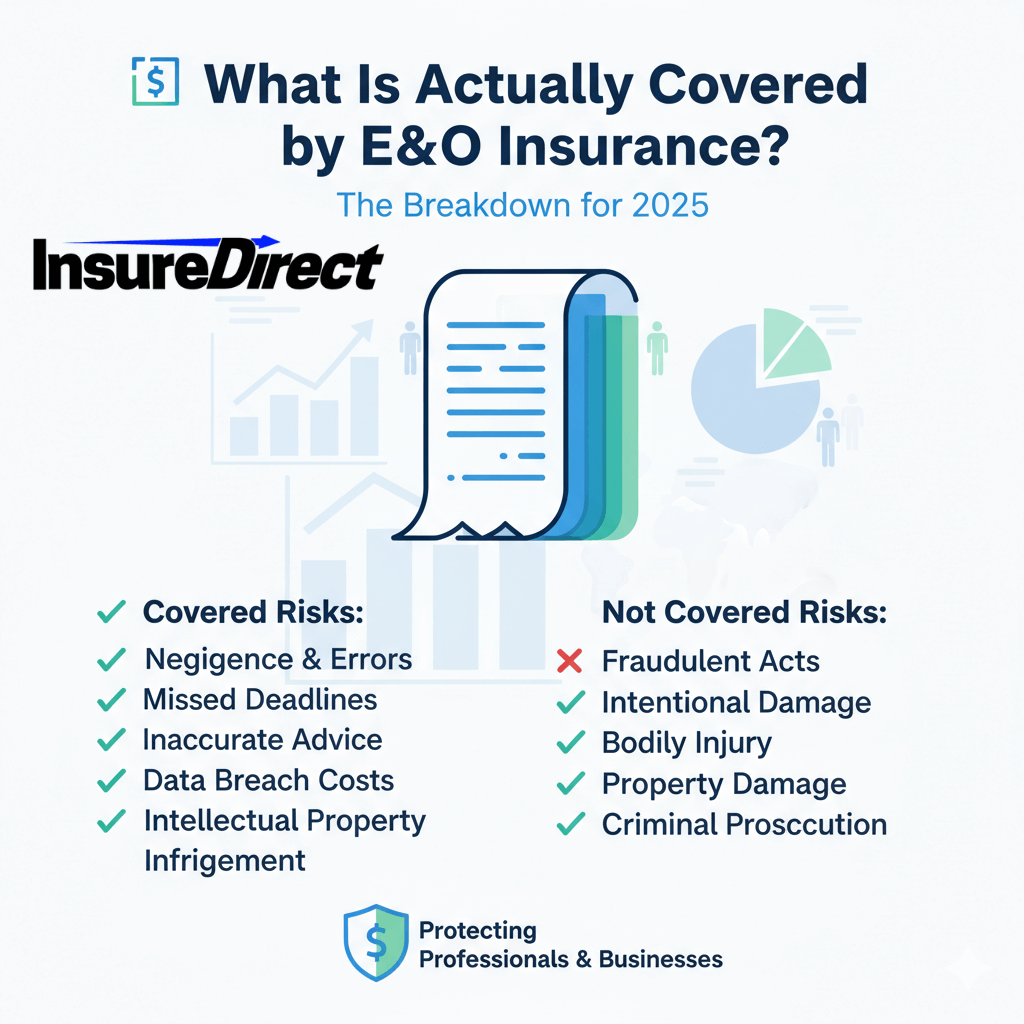
E&O is also called professional liability insurance. A policy typically responds to the claims below, beyond your deductible and up to the policy limit.
- Negligence claims: a client says your work fell below a reasonable professional standard and cost them money.
- Errors and omissions in the literal sense: a missed deadline, a wrong figure, a step left out of a process.
- Misrepresentation and inaccurate advice: a client says they were given wrong information and made a financial decision because of it.
- Legal defense costs: the cost of a lawyer to respond to a covered claim, up to the policy limit.
- Covered settlements and judgments: what you are found to owe, or agree to pay, on a covered claim.
Why Knowing What E&O Insurance Covers Matters
1. E&O answers financial-loss claims: the Insurance Information Institute lists negligence, misrepresentation and inaccurate advice among the claims professional liability covers.
2. E&O helps pay for your defense: E&O can pay legal defense costs and covered judgments or settlements, up to the policy limit.
3. E&O fills the gap general liability leaves: bodily injury and property damage belong to general liability, and professional mistakes belong to E&O.
4. Knowing the exclusions prevents expensive surprises: reading them before a claim beats finding out during one.
What E&O Insurance Does Not Cover
E&O generally leaves out intentional or dishonest acts and non-financial losses. Bodily injury and property damage are general liability insurance territory, and E&O does not replace it. Some risks, such as data breaches, may be excluded or handled by a separate policy. Read the exclusions list in your own policy to see how yours treats them.
| Situation | Does E&O typically respond? |
|---|---|
| A client says your advice cost them money | Yes, if the claim fits the policy terms |
| A client says you missed a deadline or left out a step | Yes, if the claim fits the policy terms |
| A visitor slips and is hurt at your office | No. That is general liability |
| You damage a client’s property | No. That is general liability |
| A deliberate or dishonest act | No. Generally excluded |
| A claim you already knew about when you applied | No. Generally excluded |
What Does E&O Insurance Cover? Three Everyday Examples
These are examples, not real cases. Whether a policy responds depends on its wording and exclusions.
- An accountant misses a filing deadline, and a client is charged a penalty.
- A real estate agent gives a client the wrong information about a property, and the client loses money on the deal.
- An insurance agent recommends a policy that does not cover a risk the client asked about.
See common E&O claims and how to prevent them for more patterns. To see what the same claims do to a business with no policy, read why E&O insurance is important.
Claims-Made vs Occurrence, and the Retroactive Date
When a policy applies matters as much as what it covers. E&O can be written in one of two ways.
- Claims-made: the policy must be active when the claim is made, and the incident must have happened on or after the retroactive date. Most E&O is written this way.
- Occurrence: the policy that was active when the incident happened responds, even if the claim arrives after that policy has ended. Occurrence policies exist but are less common for E&O.
The retroactive date is the date on a claims-made policy that sets how far back covered work reaches. Work done before that date is not covered, even if the claim arrives while the policy is active. A later date can leave past work uncovered, so look at it every time you renew or switch carriers.
If a claims-made policy ends because you retire, close your practice or change carriers, tail coverage, also called an extended reporting period, can extend the time you have to report claims about past work. The E&O retroactive date post covers the details.
How Limits Work
The limit is the most a policy pays. The per-claim limit caps any single claim, and the aggregate limit caps everything paid in one policy period. InsureDirect E&O comes with $1M per claim and $3M aggregate limits. Your deductible is the part of a covered claim you pay first, and the Insurance Information Institute says professional liability deductibles typically run from $1,000 to $25,000. Cost depends on your profession, size and risk, and a client contract may name a minimum limit, so read your contracts before you choose. To go deeper, read E&O coverage limits.
How to Check What Your Own Policy Covers
- Find the coverage grant. It is the paragraph that says what triggers a covered claim.
- Read the description of your professional services. Work outside that description may not be covered.
- Read the exclusions list from top to bottom.
- Find the retroactive date and compare it with the date you started the work you want covered.
- Check the per-claim limit, the aggregate limit and the deductible against your client contracts.
No policy yet? Start with do you need E&O insurance, then use the E&O insurance buying checklist when you are ready to compare.
Myths About E&O Coverage
Myth: E&O pays for any complaint a client has. An unhappy client is not automatically a claim. A claim is usually a written demand for money or services, a lawsuit, or a formal complaint, and your policy defines the term.
Myth: E&O replaces general liability. E&O handles financial loss from your professional work. General liability handles bodily injury, property damage and advertising injury. See E&O vs general liability.
Myth: E&O covers any mistake, whenever it happened. Timing rules apply. On a claims-made policy, work done before the retroactive date is not covered, and a claim or circumstance you already knew about when you applied is generally excluded.
| Quick Facts | Details |
|---|---|
| Core trigger | A client claims your professional advice, work or service caused a financial loss |
| Also pays for | Legal defense costs, up to the policy limit |
| Generally excluded | Intentional or dishonest acts and non-financial losses |
| Limits through InsureDirect | $1M per claim and $3M aggregate |
| Policy timing | Most E&O is claims-made, with a retroactive date |
Author’s note: Before you buy, read the coverage grant and the exclusions list in the policy wording, not just the summary. If you have questions, talk to a licensed InsureDirect agent.
Frequently Asked Questions
Does E&O insurance cover mistakes I did not know I made?
It can. E&O is written for honest mistakes, including ones you did not catch at the time, if the claim falls under the policy’s terms. On a claims-made policy the claim has to be made while the policy is active, and the work has to fall on or after the retroactive date.
What does errors and omissions insurance not cover?
E&O generally does not cover intentional or dishonest acts, or losses that are not financial. Bodily injury and property damage belong to general liability. Claims you knew about before you applied are generally excluded too, and every policy has its own exclusions list.
Does E&O pay for a lawyer if the claim has no merit?
For covered claims, E&O can pay legal defense costs, up to the policy limit. Whether a claim has merit is decided later, and a defense still has to be paid for along the way. Read how your policy treats defense costs, because wording differs.
What does E&O insurance cover for a small business?
The same thing it covers for a large firm: claims that your advice, work or service caused a client a financial loss, plus legal defense costs for covered claims. Exclusions, limits and price depend on your profession, size and risk, so ask a licensed agent your questions about your own line of work.
Is E&O the same as professional liability insurance?
In most cases, yes. E&O is also called professional liability, and many policies use one name or the other for the same kind of coverage. To see when the wording does differ, read professional liability vs E&O.
Can I buy E&O insurance after a client complains?
You can buy a policy, but it will not cover a claim or a problem you already knew about. E&O is meant to be in place before a dispute starts, which is why professionals buy it when they take on clients and not when a demand letter arrives.
Why Choose InsureDirect
Transparent pricing: E&O plans start at $21.05 a month or $252.60 a year, with no down payment and zero hidden fees.
Limits: $1M per claim and $3M aggregate.
Carrier: ERGO Next Insurance.
Rated: A+ (Superior) rating from AM Best.
Plain answers on coverage: a licensed InsureDirect agent can answer your questions about what an E&O policy covers by phone or online.
Get Instant Coverage and see a price for the work you do.
Sources
Insurance Information Institute, Professional liability insurance. U.S. Small Business Administration, Launch your business: get business insurance.
This article is for general educational purposes and is not a substitute for your policy’s actual terms and conditions. Coverage details, limits, and exclusions vary by policy and by state. Always review your specific policy documents or speak with a licensed agent before making coverage decisions.
Reviewed by Michael E. Dortch, President & Managing Agent, Combined Insurance Group, Ltd. Last updated: November 2026.
