

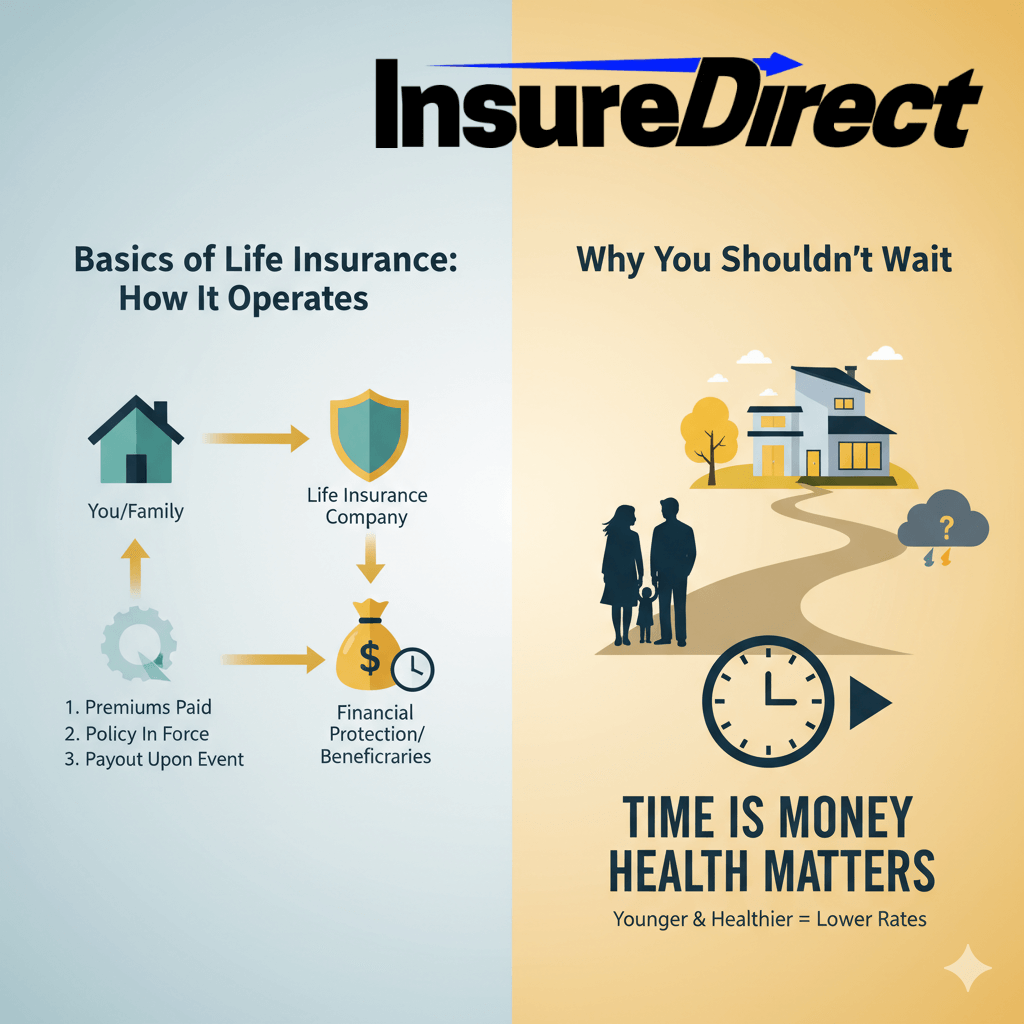
How does life insurance work? You pay a premium, and if you die while the policy is active, the insurer pays a set amount, called the death benefit, to the people you named as beneficiaries. That is the whole of it in one sentence. The rest is detail: the type of policy, the application, and the amount you choose.
Here is the short version, start to finish:
- Decide what the money is for, such as replacing income or paying off a mortgage.
- Choose a policy type and an amount, term for a set period or whole life for a lifetime.
- Apply. The insurer reviews your details and sets a price.
- Pay the premium to keep the policy active.
- Name your beneficiaries and keep the list current.
- If you die while covered, your beneficiaries file a claim with the insurer and receive the death benefit.
Get a Life Insurance Quote to see a price for your situation, or call (800) 807-0762 to talk with a licensed agent.
Quick Facts
- Two main types: Term life (set period, generally lower premium) and whole life (lifetime, may build cash value)
- Who gets paid: The beneficiaries you name
- What sets the price: Insurers commonly consider age and health, plus the type and amount of coverage
- When a term ends: Coverage expires, and renewal may be an option, though premiums may be higher
- Final expenses: The Institute says to plan for at least $15,000
How Does Life Insurance Work? The Basic Mechanism
Three parties are involved: you, the insurer and your beneficiaries. Each has one job.
- You pay the premium. Ask whether it is paid on a set schedule and whether it can change. Keep paying it, since a policy that lapses may not pay.
- The insurer carries the risk. In exchange for the premium, it agrees to pay the death benefit if you die while the policy is active.
- Your beneficiaries receive the money. You can name more than one and set each person’s share. A beneficiary can be a person or an organization.
When the insured person dies, the beneficiaries contact the insurer to file a claim, and the insurer tells them what it needs. Tell your beneficiaries that the policy exists and where the paperwork is kept. A policy nobody knows about cannot help anyone.
Myths About Life Insurance
Myth: Life insurance through your job is all the coverage you need. Coverage tied to your job can end when you change jobs, and the Institute advises against relying on it.
Myth: A whole life policy pays the cash value on top of the death benefit. The cash value usually stays with the insurer when the insured dies, and loans against it may reduce the death benefit.
Myth: Twenty times your salary is the right amount for everyone. The Institute calls that common rule simplistic because it ignores inflation and other income. Build the number from your own household’s needs instead.
Term vs Whole Life: Renting or Owning
A large part of the question “how does life insurance work” is really a question about which type you buy. There are two main types.
- Term life insurance lasts a set period, such as 1, 5, 10 or sometimes as much as 30 years. Coverage expires when the period ends, and term policies do not build cash value. Renewal may be an option, but the premiums may be higher.
- Whole life insurance lasts your lifetime as long as premiums are paid. Premiums can be higher than for term. It may build cash value that you can access under certain conditions, and loans against the cash value may reduce the death benefit.
A simple way to picture the difference is renting versus owning a home. Term life is like renting. You pay for the use of the coverage for a set time, the cost is generally lower, and when the lease is up you walk away with nothing to cash in. Whole life is closer to owning. You pay more, the coverage is yours for life as long as you keep paying, and part of what you pay may build value over time. Neither is the wrong choice. It depends on how long you need the protection and what you can keep paying.
Term generally costs less than permanent life insurance. See term vs whole life insurance for a closer comparison.
What Happens When You Apply
To price a policy, an insurer looks at details such as your age and health. This review is called underwriting. What the insurer asks for, and whether a medical exam is part of it, depends on the insurer, the policy and the amount of coverage. See what affects life insurance premiums, and read life insurance with pre-existing conditions if a health condition applies to you.
Many policies include a contestability period early in the policy’s life. If the application contained inaccurate information, the insurer may contest a claim made in that window, so answer every question completely and accurately.
Choosing a Coverage Amount
Start with what the people who depend on you would need. The Insurance Information Institute says coverage, together with other income, should replace what you provide:
- Income: what your household would lose if your paycheck stopped.
- Services: the cost of replacing what you do, such as household work.
- One-time needs: schooling, relocation or a mortgage balance.
- Final expenses: funeral, taxes and estate administration. The Institute says to plan for at least $15,000.
Then subtract other sources, such as Social Security survivor benefits and employer coverage. If no one depends on your income and you can cover final expenses, you may not need life insurance at all. The full walk-through is in how much life insurance you need.
Why Starting Early Matters
1. Age and health shape the price: insurers commonly consider both, so the same coverage generally costs more the later you apply.
2. Health can change: a new condition before you apply can change what an insurer offers and what it charges.
3. People may depend on your income: a death benefit can help replace that income and cover a mortgage, other debts and final expenses.
4. You get time to choose: applying before you need coverage lets you compare options without pressure.
Frequently Asked Questions
How does life insurance work in simple terms?
You pay a premium to an insurer. If you die while the policy is active, the insurer pays the death benefit to the beneficiaries you named. Term policies cover a set period, and whole life policies are built to last your lifetime as long as premiums are paid.
What happens if I outlive my term life policy?
The coverage ends when the term does, and there is no cash value to collect. Renewal may be an option, so ask about it before the term runs out. A renewed policy may cost more, and it is worth asking whether the right to renew ends at a certain age.
Can I name more than one beneficiary?
Yes, you can generally name more than one beneficiary and set the share of the death benefit each one receives. Review the list after big life changes such as a marriage, a divorce or a new child.
What is the contestability period?
It is a window early in a policy’s life when the insurer may look closely at the application if a claim is made. The length is stated in your policy and rules vary by state, so read that section before you sign.
How much life insurance do I need?
It depends on your household. Add up the income, services and one-time needs your family would lose, add final expenses, and subtract other sources such as Social Security survivor benefits. A licensed agent can answer your questions as you work through it.
How much does life insurance cost?
The cost depends on the details, including the type of policy, the amount of coverage and what the insurer learns about your age and health. The way to know your own price is to get a quote. Get a Life Insurance Quote or call (800) 807-0762.
Author’s note: Before you apply, write down who depends on your income, what debts you carry and how many years of support they would need. When you are ready, talk to a licensed InsureDirect agent or start a quote online.
Why Choose InsureDirect
Questions answered before you apply: a licensed InsureDirect agent can answer your questions about term and whole life by phone or online.
Independent since 1992: InsureDirect has been helping individuals, families, and businesses get covered for more than 30 years.
Your price, not an average: cost changes with your details. Get a quote built on them, or call (800) 807-0762 to speak with a licensed agent.
Get a Life Insurance Quote built around your household.
Sources
Insurance Information Institute, What are the principal types of life insurance? and How much life insurance do I need?. NAIC, Life insurance consumer information.
This article is for general educational purposes and is not a substitute for your policy’s actual terms and conditions. Coverage details, limits, and exclusions vary by policy and by state. Always review your specific policy documents or speak with a licensed agent before making coverage decisions.
Reviewed by Michael E. Dortch, President & Managing Agent, Combined Insurance Group, Ltd. Last updated: November 2026.
