

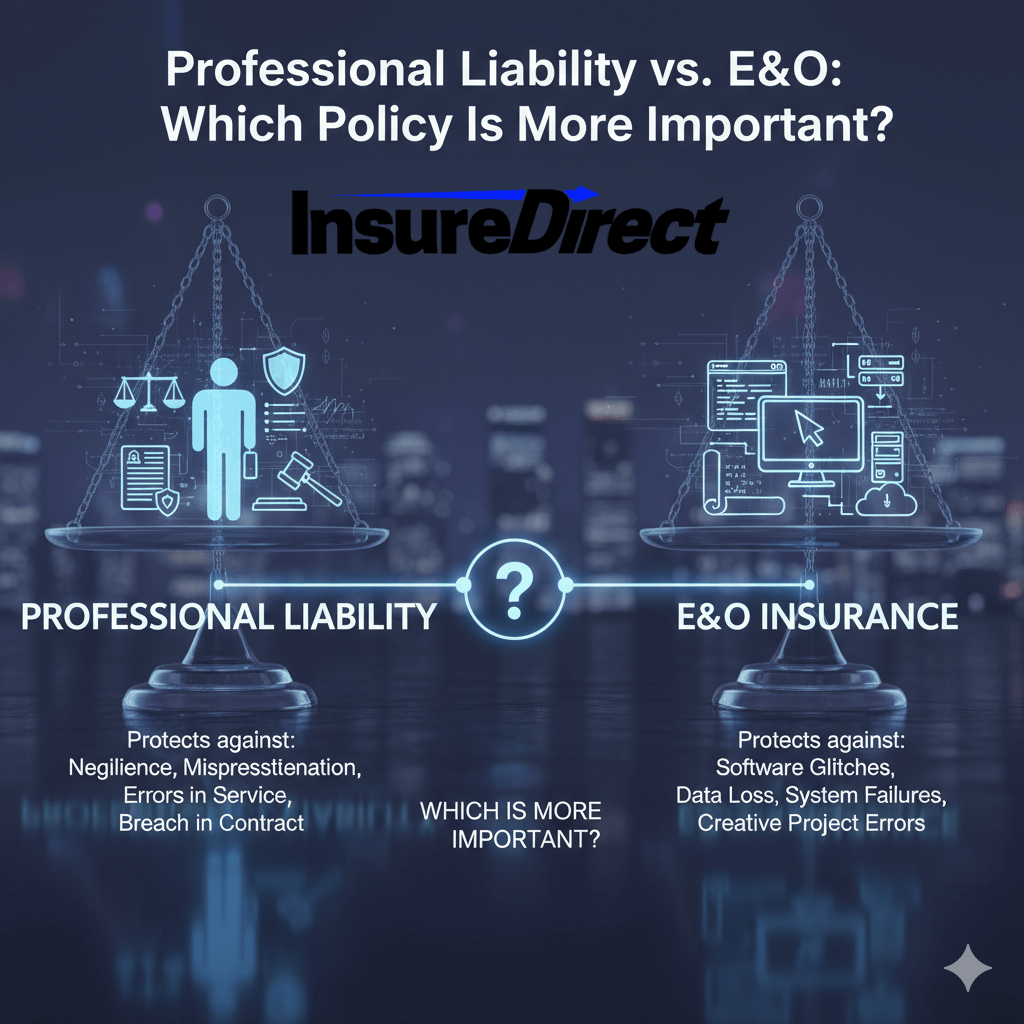
Professional liability vs errors and omissions insurance: in most cases there is no contest, because they are the same coverage under two names. Errors and omissions (E&O) insurance is the label some insurers and professions use, and professional liability is the label others use. The Insurance Information Institute says professional liability insurance is also known as errors and omissions insurance.
So when a client asks for one and your policy says the other, you are usually looking at the same kind of protection. What matters is what the policy covers. Get Instant Coverage to price E&O for your own work. If you sell life or health insurance, see the E&O program for life and health agents.
| Quick Facts | Details |
|---|---|
| Same coverage? | In most cases, yes. E&O is also called professional liability |
| What both cover | Claims that your advice, work or service caused a client a financial loss |
| What both generally leave out | Intentional or dishonest acts and non-financial losses |
| Where they truly differ | Malpractice policies, and the wording from one policy to the next |
| How most E&O is written | Claims-made, with a retroactive date |
Professional Liability vs. Errors and Omissions Insurance: Why Two Names?
Insurers and professions do not all use the same label, so one carrier may call a policy professional liability while another calls a similar policy E&O. The core idea is the same under either name. It protects you when a client makes a claim for financial loss and says your advice, work or service contained a mistake or a missed detail. It pays legal defense costs and covered settlements or judgments, beyond your deductible and up to the policy limit, and it generally leaves out intentional or dishonest acts and non-financial losses. The full list is in what E&O insurance covers.
How the Two Names Are Used by Profession
Which label you see depends mostly on habit in your field. This is common usage, not a rule, and an insurer can use either name.
- Real estate: brokerages and state real estate commissions usually say E&O.
- Consultants, IT and design: client contracts use both names.
- Accountants, architects and engineers: professional liability is the more common label.
- Medicine and law: the policy is called malpractice insurance, and it is written for those professions.
If a contract or a licensing rule names one term, what counts is the coverage it describes. See E&O insurance requirements by industry for who usually asks for it.
When the Difference Is Real
- Malpractice insurance: the Institute calls legal and medical malpractice policies special types of professional liability insurance. If you provide clinical care, read about E&O insurance for healthcare professionals and ask a licensed agent which policy fits each part of your work.
- General liability: a different policy. It handles bodily injury, property damage and advertising injury to third parties, not professional mistakes. See E&O vs general liability.
- Business owner’s policy: a BOP bundles property, liability and business income coverage. The Institute says professional liability is not included in a BOP or in an in-home business policy.
| Policy | What it answers | Same as E&O? |
|---|---|---|
| Professional liability | A claim for financial loss from your professional work | Yes, in most cases |
| Malpractice | Professional liability written for fields such as medicine and law | A special type |
| General liability | Bodily injury, property damage and advertising injury | No |
| Business owner’s policy | Property, liability and business income | No. Professional liability is not included |
Policy Terms That Matter More Than the Title
Most E&O policies are written on a claims-made basis. That means the policy must be active when the claim is made, and the incident must have happened on or after the retroactive date. If a claims-made policy ends, tail coverage, also called an extended reporting period, can extend the time you have to report a claim. Learn how the E&O retroactive date works before you compare quotes, because a later date can leave past work uncovered.
How to Compare Two Policies
When one quote says professional liability and the other says errors and omissions insurance, compare the wording and not the names.
- Read the coverage grant: the paragraph that says what triggers a covered claim, not the policy title.
- Compare the exclusions line by line: this is where similar policies can differ.
- Check the limit and the deductible: the Institute says professional liability deductibles generally range from $1,000 to $25,000, so ask what you would pay first.
- Compare retroactive dates: ask whether the date reaches back as far as your past work, and whether tail coverage is available if you switch carriers later.
The E&O insurance buying checklist puts these steps in order. Still deciding whether the coverage is worth having? Read why E&O insurance is important.
Why the Name on Your Policy Matters Less Than What It Covers
1. Same protection, different label: E&O is also called professional liability, so one kind of coverage can show up under either name.
2. Your contract may name one term: a client or contract may ask for one label, so check what is really being asked for.
3. The terms matter more than the title: the coverage grant, exclusions, claims-made timing and retroactive date decide what a policy will respond to.
4. Avoid paying twice: a second policy for the same risk can mean overlapping coverage, so ask an agent before you add one.
Frequently Asked Questions
Is E&O the same as professional liability insurance?
In most cases, yes. The Insurance Information Institute describes professional liability as another name for E&O. The wording of the policy still decides what is covered, so read the coverage grant and the exclusions.
Why does my policy say professional liability instead of E&O?
Different insurers and professions use different labels for similar coverage, and neither name is more correct. If a client or a contract asks for the other term, compare what the policy covers with what the contract describes instead of comparing titles.
Do I need both professional liability and E&O insurance?
In most cases one policy does the job under either name. Before you buy a second one for the same risk, ask a licensed agent about it, because you may be paying for overlapping coverage.
How is malpractice insurance different from E&O?
Malpractice policies for fields such as law and medicine are special types of professional liability insurance, according to the Insurance Information Institute. If you provide clinical care, ask a licensed agent which policy answers each part of your work.
What is tail coverage and when do I need it?
Tail coverage, also called an extended reporting period, can extend the time you have to report a claim after a claims-made policy ends. You may want it when a claims-made policy is canceled or not renewed and you still want protection for past work. Ask about it before you cancel, since availability and cost depend on the policy.
Myths About Professional Liability vs Errors and Omissions Insurance
Myth: Professional liability and E&O are two separate policies. E&O is also called professional liability, so a policy under either name can be the same coverage.
Myth: A general liability or business owner’s policy already includes professional liability. It does not. General liability handles bodily injury, property damage and advertising injury, and the Institute says a BOP leaves professional liability out.
Myth: Buying both policies is the safe choice. For the same risk, a second policy can mean paying twice for overlapping coverage. Ask a licensed agent whether it adds anything.
Author’s note: If a client or a contract asks for one term and your policy uses the other, do not assume you are missing coverage. Read the coverage grant first, or talk to a licensed InsureDirect agent with your questions.
Why Choose InsureDirect
Transparent pricing: E&O plans start at $21.05 a month or $252.60 a year, with no down payment and zero hidden fees.
Limits: $1M per claim and $3M aggregate.
Carrier: ERGO Next Insurance.
Rated: A+ (Superior) rating from AM Best.
Two names, one conversation: if a client asks for one name and your policy uses the other, a licensed InsureDirect agent can answer your questions by phone or online.
Get Instant Coverage and get a quote for your own work.
Sources
Insurance Information Institute, Professional liability insurance and Understanding business owners policies.
This article is for general educational purposes and is not a substitute for your policy’s actual terms and conditions. Coverage details, limits, and exclusions vary by policy and by state. Always review your specific policy documents or speak with a licensed agent before making coverage decisions.
Reviewed by Michael E. Dortch, President & Managing Agent, Combined Insurance Group, Ltd. Last updated: November 2026.
