

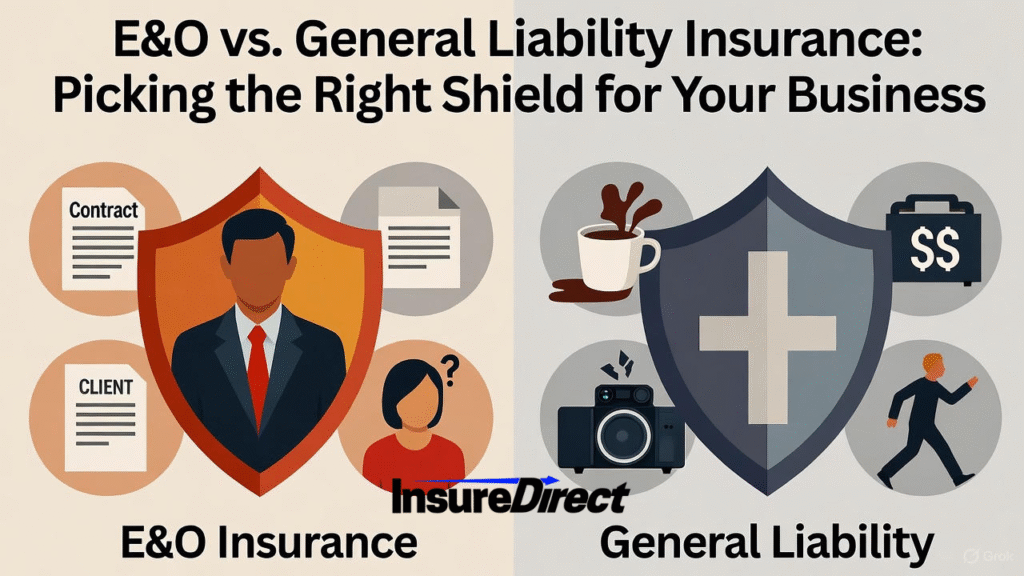
E&O vs general liability insurance comes down to one question: what went wrong? Errors and omissions (E&O) insurance protects you when your professional work or advice costs a client money. General liability protects you when your business hurts someone or damages their property. Mix them up and a gap can open exactly where a claim lands.
The short version: E&O covers mistakes in what you do for clients, and general liability insurance covers accidents connected to your business. Many businesses need both. Get Instant Coverage to price the E&O side. If you sell life or health insurance, the E&O program for life and health agents is the place to start.
| Quick Facts | Details |
|---|---|
| E&O covers | Financial loss from errors, omissions or poor advice in your professional work |
| General liability covers | Bodily injury, property damage, personal and advertising injury |
| Typically written | E&O claims-made, general liability occurrence basis |
| Many businesses need | Both, depending on what they sell and where they work |
E&O vs General Liability Insurance: What Each Policy Covers
General liability protects a business against third-party claims of bodily injury, property damage, and personal and advertising injury, such as libel, slander or copyright infringement in your advertising. It also pays medical payments for on-site injuries, legal defense, and covered settlements or judgments. See what general liability insurance is for each piece.
E&O, also called professional liability, protects you when a client says your advice, work or service contained a mistake or missed detail that caused a financial loss. It typically pays the cost of legal defense and covered settlements or judgments, beyond your deductible and up to the policy limit. The Insurance Information Institute notes that coverage generally does not extend to intentional or dishonest acts. See what E&O insurance covers for the details.
| Question | E&O insurance | General liability insurance |
|---|---|---|
| Typical claim | A client says your advice or work cost them money | A visitor is hurt, or your work damages someone’s property |
| Type of loss | Financial loss from a professional error or missed detail | Bodily injury, property damage, personal and advertising injury |
| Who makes the claim | A client or customer who relied on your work | A third party such as a customer, visitor or neighbor |
| Usually pays for | Legal defense and covered judgments or settlements | Legal defense, medical payments, and covered judgments or settlements |
| How it is often written | Claims-made | Occurrence basis |
Wording differs by carrier, so check your own policy form before relying on any table.
Why Knowing the Difference Is Essential
1. No gap where a claim lands: a client who says your advice cost them money is an E&O claim. A visitor who slips in your office is a general liability claim. Each policy answers one and not the other.
2. Buying only what you need: once you know what each policy does, you can skip what does not fit your work and add what is missing.
3. Contracts and clients: some clients and landlords ask for proof of one policy and some ask for both. Knowing the difference lets you answer quickly and correctly.
4. The right call when trouble starts: you know which policy to report to, so a claim reaches the right place on day one.
When You Need One, the Other, or Both
- Consultants, accountants, designers and other service providers: E&O comes first, since the main risk is advice or work product. Add general liability if clients visit you or you work on their premises. See E&O insurance for consultants.
- Contractors and tradespeople: general liability comes first, since the main risk is injury or damage on a job. E&O matters too if you design, specify or advise.
- Shops, restaurants and other places the public walks into: general liability is the core policy. Add E&O only if you also sell advice or services.
- Software developers and IT firms: often both. A missed deadline or a bug that costs a client revenue points to E&O, while a visitor hurt at your office points to general liability.
- Marketing and advertising agencies: E&O is the one to look at first. Standard general liability policies typically exclude advertising injury for businesses whose own business is advertising, broadcasting, publishing or media, so do not count on general liability for a claim over a campaign you built for a client.
- Insurance agents and brokers: a missed coverage detail or a wrong recommendation that leaves a client unprotected is an E&O problem.
InsureDirect offers both policies, so you can get a quote for each and see what each one adds. Not sure what a general liability policy leaves out? Read what is excluded from a general liability policy.
One Business, Two Claims: An Everyday Example
Picture a bookkeeper who works from a small rented office. Two things go wrong in the same year.
- Claim one: a client says a filing was sent late and that the delay cost the business money. That is a claim for financial loss tied to professional work, so it goes to the E&O policy.
- Claim two: a delivery driver trips over a loose cable in the office and breaks a wrist. That is bodily injury to a third party, so it goes to the general liability policy.
Neither policy answers the other one’s claim. This is an illustration, and what any policy pays depends on its own terms.
How the Two Policies Respond Over Time
Most E&O policies are written on a claims-made basis. The policy must be active when the claim is made, and the incident must have happened on or after the retroactive date. General liability is commonly written on an occurrence basis, which ties coverage to when the injury or damage happened, even if the claim shows up later. If you plan to switch E&O carriers, read about the E&O retroactive date first.
E&O vs General Liability Insurance: How to Decide in Four Steps
- List what you sell. Advice, designs, filings and recommendations point to E&O. Physical work, products and premises open to the public point to general liability.
- List where you work. If clients come to you, or you go to their sites, an injury or property damage claim is possible.
- Read your contracts and your lease. Write down which policy each one names and the limits it asks for.
- Get a quote for each policy you need. If the same business has both kinds of risk, carry both. For the two names people use for the first policy, see professional liability vs errors and omissions insurance.
Myths About E&O and General Liability
Myth: General liability will cover a client’s complaint about your work. Not usually. A claim that your advice or service caused a financial loss is the kind of claim professional liability is built for.
Myth: E&O will pay for an injury at your office. No. A slip and fall is bodily injury, which is a general liability claim.
Myth: A business owner’s policy is all a service business needs. A business owner’s policy, or BOP, bundles general liability with property and business income coverage. The Insurance Information Institute notes that professional liability is not included in a BOP, so a service business usually needs a separate E&O policy.
Author’s note: The E&O vs general liability insurance question often answers itself once you read the contract. Before you sign a contract or a lease, write down which policy it names and which limits it asks for. If the wording is unclear, talk to a licensed InsureDirect agent before you sign.
Frequently Asked Questions
Is E&O the same as general liability insurance?
No. E&O covers financial loss caused by errors, omissions or poor advice in your professional work. General liability covers bodily injury, property damage, and personal and advertising injury caused by your business. One does not stand in for the other, so many businesses carry both.
E&O insurance vs general liability: which one should I buy first?
Start with the one that matches your biggest risk. If you are paid for advice or a professional service, that is usually E&O. If the public walks into your premises or you do physical work at job sites, that is usually general liability. Contracts and leases often settle the question by naming the policy they want.
Do I need both E&O and general liability?
Many businesses do. If you give advice or deliver a service, and customers also visit you or you work at their sites, both risks are real. If you are unsure which applies to your work, ask a licensed agent your questions before you buy.
Does general liability cover professional mistakes?
Generally no. The Insurance Information Institute describes negligence, misrepresentation and inaccurate advice as claims that professional liability is written for, and it notes that professional liability is not included in a business owner’s policy. Check your own policy wording for the exact terms.
Which policy do clients usually ask to see?
It depends on the contract. Clients who hire you for advice or services often ask for E&O, while landlords and clients who have you on their property often ask for general liability. Some ask for both.
Which policy do insurance agents need?
E&O fits an agent’s core risk, since a missed coverage detail or a wrong recommendation can leave a client unprotected. Life and health agents can start with the E&O program for life and health agents.
Why Choose InsureDirect
Transparent pricing: E&O plans start at $21.05 a month or $252.60 a year, with no down payment and zero hidden fees.
Limits: $1M per claim and $3M aggregate.
Carrier: ERGO Next Insurance.
Rated: A+ (Superior) rating from AM Best.
Both policies in one place: InsureDirect offers E&O and general liability, and licensed agents answer questions at (800) 807-0762.
Get Instant Coverage for E&O, or get a general liability quote if you need that side covered.
Sources
Insurance Information Institute, Professional liability insurance, Small business insurance basics, and Understanding business owners policies.
This article is for general educational purposes and is not a substitute for your policy’s actual terms and conditions. Coverage details, limits, and exclusions vary by policy and by state. Always review your specific policy documents or speak with a licensed agent before making coverage decisions.
Reviewed by Michael E. Dortch, President & Managing Agent, Combined Insurance Group, Ltd. Last updated: November 2026.
