

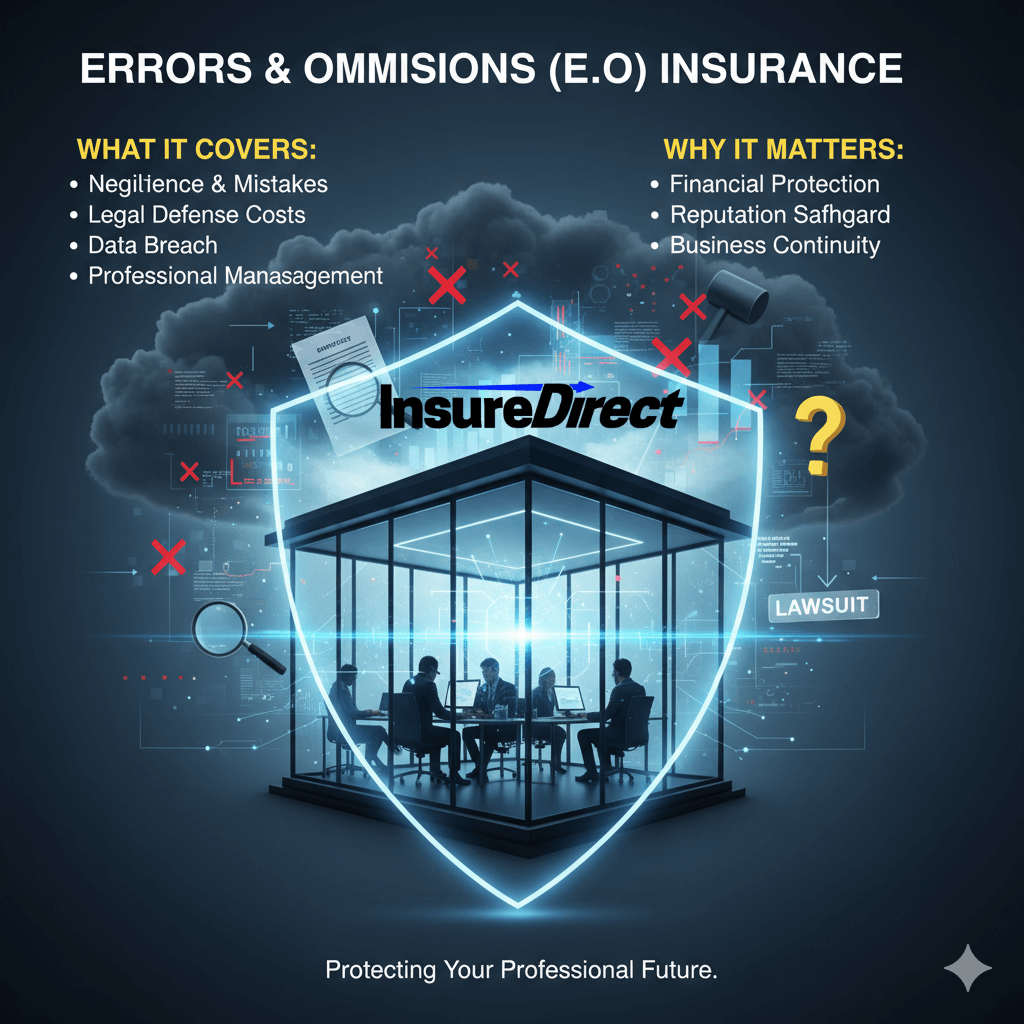
Here is why E&O insurance is important: a client can say your advice, work or service cost them money, and answering that claim costs money too. With errors and omissions (E&O) insurance, a covered claim can be paid up to the limit, including legal defense costs, beyond your deductible. Without it, every dollar comes out of your own pocket.
This post looks at what happens to a business that skips E&O and then faces a real claim, and at how the policy protects you when a claim turns into a lawsuit. Get Instant Coverage so your policy is already active when a claim arrives. If you write life or health policies, go straight to the E&O program for life and health agents.
Why E&O Insurance Is Important Before a Claim Arrives
1. Defense costs start early: a claim has to be answered before anyone knows whether it has merit, and a defense costs money either way.
2. The policy has to be active first: most E&O is claims-made, so the policy must be active when the claim is made, and the incident must have happened on or after the retroactive date.
3. A policy can carry the cost: it can pay legal defense costs and covered settlements or judgments, beyond your deductible and up to its limit.
4. Clients may ask for proof: some client contracts ask for it before you sign, and your Certificate of Insurance is in your online account once the policy is active.
What Happens When a Claim Arrives
A client says your advice, a missed step or a piece of incorrect information cost them money. It may start with an angry email or a letter from a lawyer. From that point you need a legal defense, and a defense costs money whether or not the claim has merit.
What the Bill Looks Like Without Coverage
- Defense costs: legal fees start as soon as the claim arrives, and you pay them as they come in.
- Settlements and judgments: if the claim ends in one, the amount comes from the business or the professional, not an insurer.
- Your time: every hour spent on letters, documents and meetings is an hour not spent on paying clients.
- Your decisions: with no insurer involved, you choose the lawyer, fund the defense and decide alone whether to settle.
How E&O Insurance Protects You From Lawsuits
A lawsuit moves in stages, and a policy does something at each one. Here is how E&O protects you from lawsuits that fall within its terms:
- You report the claim. Tell the carrier as soon as you receive a demand letter, a complaint or legal papers. Claims are handled by the insurance carrier, and policies commonly require prompt notice.
- The carrier looks at coverage. It checks that the policy is active, that the work happened on or after the retroactive date, and that no exclusion applies.
- A defense is arranged. For a covered claim, the policy pays for the lawyer and the other costs of answering the suit. In some policies those defense costs count against your limit, so read that section.
- The claim is resolved. If it ends in a covered settlement or judgment, the policy pays beyond your deductible, up to the limit. Anything above the limit stays with you, so read how E&O coverage limits work.
E&O generally does not cover intentional or dishonest acts, and it does not cover bodily injury or property damage, which belong to general liability. For the full picture, see what E&O insurance covers. For the reporting steps, read how to file an E&O claim.
A Realistic Scenario, With and Without a Policy
This is an example, not a real case. A bookkeeper misses the due date on a vendor invoice. The client says the mistake cost them a late fee and a lost discount, and a lawyer’s letter asks for compensation.
| Stage | With E&O in place | Without E&O |
|---|---|---|
| Lawyer’s letter arrives | Report it to the carrier | Find and hire a lawyer yourself |
| Legal defense | Paid for a covered claim, beyond your deductible | Paid from business or personal savings |
| Settlement or judgment | Paid for a covered claim, up to the limit | Paid by you |
| Settlement decision | Made under the policy’s settlement terms | Made alone, with your own money at stake |
The mistake is the same in both columns. The difference is who pays, and that is why E&O insurance is important for anyone whose work clients rely on.
Who Decides Whether to Settle
Policies differ on this point. Many E&O policies need your consent before the carrier settles a claim. Some also limit what the carrier pays if you refuse a settlement it recommends, which can leave you paying the difference. Find the settlement section in your policy and read it before you ever need it.
What to Do Next
- Ask whether a client could lose money because of your work. Do you need E&O insurance gives you four questions to test it.
- Read the insurance clause in your current contracts and note any limit it names.
- Get a quote, then go through the E&O insurance buying checklist before you buy.
- Once the policy is active, save your Certificate of Insurance and write down how to report a claim.
| Quick Facts | Details |
|---|---|
| What starts first | Defense costs, as soon as the claim arrives |
| Who pays without E&O | The business or the professional |
| What E&O can pay | Legal defense costs and covered settlements or judgments, beyond your deductible and up to the limit |
| Timing rule | The policy must be active when the claim is made, and the incident must fall on or after the retroactive date |
| Known problems | Not covered by a policy bought afterward |
Frequently Asked Questions
Why is E&O insurance important for a small business?
A small business usually has no legal department and no reserve set aside for lawsuits. One client claim can bring a defense bill and a settlement demand at the same moment. E&O moves the cost of a covered claim to the carrier, beyond your deductible and up to the policy limit.
Does it matter if the claim against me turns out to be false?
Yes, because a defense still has to be paid for while the claim is sorted out, so the cost starts early. For covered claims, E&O can pay legal defense costs up to the policy limit, even when the claim has no merit.
Who decides whether to settle an E&O claim?
It depends on your policy. Many E&O policies need your consent to settle, and some limit what the carrier pays if you refuse a settlement it recommends. Read the settlement section of your policy before you need it.
Can I buy E&O insurance after a client has complained?
You can buy a policy, but it will not cover a claim or a problem you already knew about. A new policy looks forward to claims you do not know about yet. If a problem is already on the table, speak with an attorney about your options.
What does a claim cost a business that has no E&O policy?
The business pays the legal defense bill and any settlement or judgment itself. The amount depends on what the client says they lost and how long the dispute runs, so no single number fits everyone.
How much does E&O insurance cost?
E&O through InsureDirect starts at $21.05 a month or $252.60 a year, with no down payment and limits of $1M per claim and $3M aggregate. Your own price depends on your profession, size and risk, so see how much E&O insurance costs for what moves it.
Myths About Skipping E&O
Myth: A claim only happens after a real mistake. A client only has to allege one. A claim can come from a mistake, a misunderstanding or an unmet expectation, and it still has to be answered.
Myth: A general liability policy covers a client’s complaint about your work. General liability handles bodily injury, property damage and advertising injury. A claim that your advice or service caused a financial loss points to E&O. See E&O vs general liability.
Myth: A small business can simply absorb a claim. The size of a claim follows what the client says they lost, not how big your business is. Without a policy, the full defense bill and any settlement land on you.
Author’s note: Look at your own contracts and clients and ask what one claim would cost you. That exercise shows why E&O insurance is important faster than any list. If you have questions about how E&O fits your work, talk to a licensed agent.
Why Choose InsureDirect
Transparent pricing: E&O plans start at $21.05 a month or $252.60 a year, with no down payment and zero hidden fees.
Limits: $1M per claim and $3M aggregate.
Carrier: ERGO Next Insurance.
Rated: A+ (Superior) rating from AM Best.
Talk it through first: if you are weighing whether the risk is real for your work, a licensed InsureDirect agent can answer your questions by phone or online.
Get Instant Coverage so your policy is already active when a claim arrives.
Sources
Insurance Information Institute, Professional liability insurance. U.S. Small Business Administration, Launch your business: get business insurance.
This article is for general educational purposes and is not a substitute for your policy’s actual terms and conditions. Coverage details, limits, and exclusions vary by policy and by state. Always review your specific policy documents or speak with a licensed agent before making coverage decisions.
Reviewed by Michael E. Dortch, President & Managing Agent, Combined Insurance Group, Ltd. Last updated: November 2026.
