

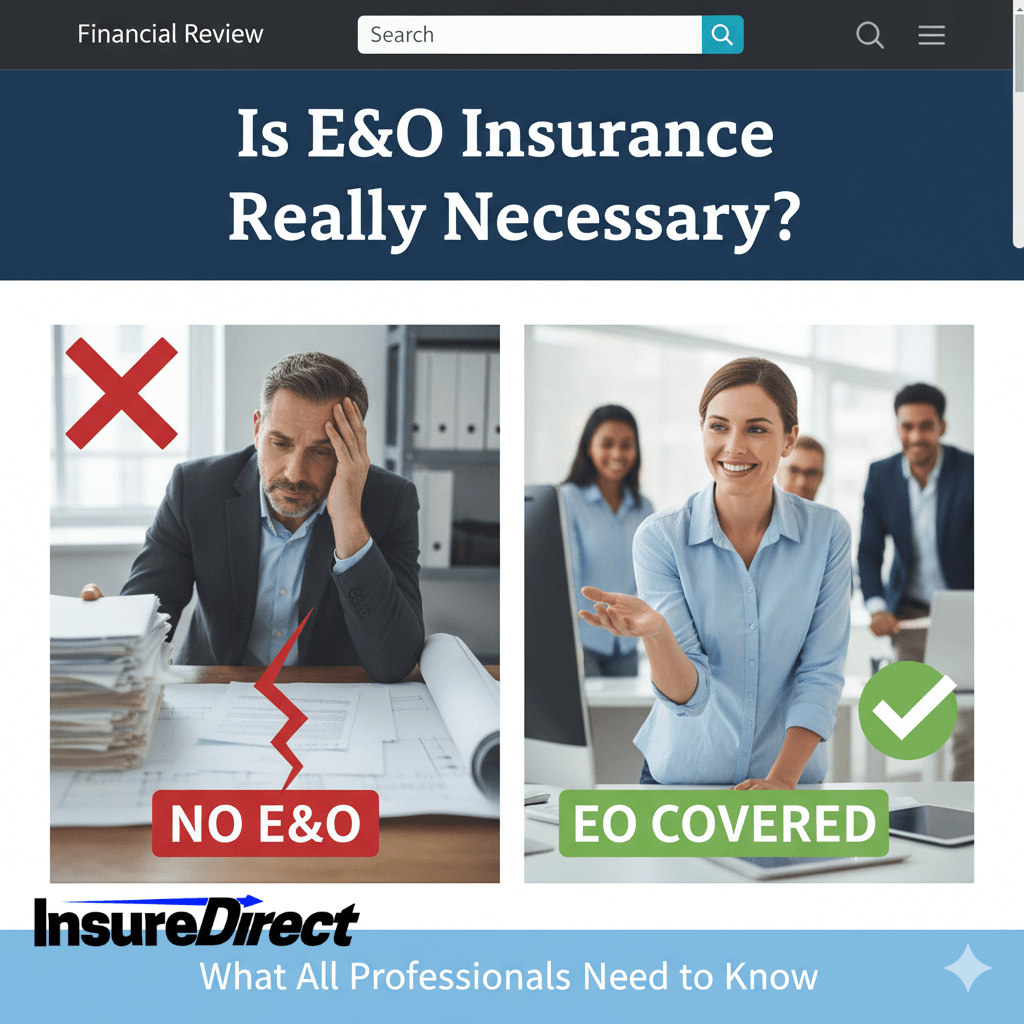
Do I need E&O insurance? It is the question a new contract, a new client or a close call tends to raise. If clients rely on your advice, work or service to make decisions about money, and a mistake on your part could cost them, then yes, errors and omissions (E&O) insurance is worth having. If that does not describe your work, you may not need it.
The four questions below settle it for your own work. Get Instant Coverage once you have your answer, or call (800) 807-0762 to ask a licensed agent. If you sell life or health insurance, start with the E&O program for life and health agents.
Do I Need E&O Insurance? Answer These Four Questions
- Does a client rely on your advice, analysis or recommendation to make a decision that affects their money?
- Could a mistake, a missed step or a piece of bad advice on your part cost a client money, even if nobody was hurt and nothing was broken?
- Do you sign contracts with an indemnification clause or a hold harmless agreement that could pass professional risk onto you?
- Would a single client lawsuit, even a groundless one, be expensive enough in legal fees alone to hurt your business?
If you answered yes to two or more, E&O insurance is worth pricing out. If you answered yes to all four, get a quote now instead of later.
Who Needs E&O Insurance: Four Everyday Examples
These are illustrations, not real cases. Each one shows the kind of claim that makes people ask who needs E&O insurance.
- A life insurance agent: a client says the agent never explained that a policy would lapse if a premium was missed. The family finds out after the coverage is gone and wants the agent to make up the loss. See the common E&O claims against life and health agents.
- A bookkeeper: a payroll filing goes in late, and the client is charged a penalty. The client asks the bookkeeper to pay it.
- A real estate agent: a buyer says a known problem with the property was never disclosed and blames the agent for the repair bill. More in E&O insurance for real estate agents.
- An IT consultant: a system change takes a client’s online store down for a weekend, and the client claims the lost sales. More in E&O insurance for consultants.
None of these involves an injury or broken property, so a general liability policy would not answer them. Each is a claim for financial loss tied to professional work, which is what E&O insurance covers. To see where each policy applies, read E&O vs general liability.
Weighing the Premium Against One Defense Bill
The premium is a number you know in advance. E&O through InsureDirect starts at $21.05 a month or $252.60 a year, with no down payment. A defense bill is a number nobody knows in advance. A lawyer bills for time, the meter starts with the first demand letter, and it keeps running until the claim is settled, dropped or decided.
| Cost | With an E&O policy | Without one |
|---|---|---|
| Your yearly cost | The premium, known up front | Nothing, until a claim arrives |
| Legal defense | Paid by the policy for a covered claim, beyond your deductible | Paid by you, from the first letter |
| Settlement or judgment | Paid for a covered claim, up to the policy limit | Paid by you or your business |
| How large it can get | Your deductible, plus anything above the limit | No ceiling |
A policy does not make every cost disappear. You pay the deductible, and the Insurance Information Institute puts typical E&O deductibles at roughly $1,000 to $25,000, so read yours. Exclusions apply, and anything above the limit stays with you. Still, the trade is a fixed, small cost against an open-ended one. An E&O premium is also generally a business expense at tax time, as explained in is E&O insurance tax deductible.
When Clients and Contracts Ask for It
Some clients ask for proof of E&O before they sign. The request may sit in an insurance clause or in a vendor requirements form.
Read any indemnification clause closely. It can require you to cover a client’s losses if your work causes harm, and sometimes the client’s legal costs too. A policy may treat liability you take on by contract differently from liability the law would impose anyway, so ask a licensed agent your questions about the clause before you sign.
Few professions are required by state law to carry E&O, and the rules differ by state and profession. Check with your state licensing board, and see E&O insurance requirements by industry for where the rules usually come from.
What to Do If You Are Still Unsure
- List the services you sell and mark the ones a client could act on financially.
- Read the insurance clause in your recent contracts and note any limit it names.
- Write down the worst mistake that could realistically happen in your work and who would lose money from it.
- Get a quote so you are weighing a real price, then go through the E&O insurance buying checklist before you buy.
Why This Decision Matters
1. Clients rely on your advice: if your work can cost a client money, you carry that exposure.
2. Contracts may ask for it: a client contract can include an insurance clause that asks for proof of E&O before you sign.
3. Size does not remove the risk: a one-person business can face a claim just as a large firm can.
4. Coverage has to be in place first: you can buy a policy after a client threatens to sue, but it will not cover a claim or a problem you already knew about.
Myths About Needing E&O
Myth: Good work means no claim. A claim is an allegation, so it can be made even when your work was sound.
Myth: A strong contract means you do not need E&O. A good contract helps define the job, but a client can still allege a mistake, and a defense still has to be paid for.
Myth: A general liability policy covers a client’s complaint about your work. General liability covers bodily injury, property damage and advertising injury. A claim that your advice caused a financial loss points to E&O.
| Quick Facts | Details |
|---|---|
| Fastest check | Answer the four questions above. Two or more yeses means price it out |
| Common reason to need it | Clients rely on your advice, work or service for decisions about money |
| Where proof is asked for | Client contracts, insurance clauses and vendor requirements |
| Timing | Buy before a problem shows up, since a known problem is not covered by a new policy |
| Legal requirement | Rules vary by state and profession |
Author’s note: If any of the four questions was a close call, write down what is unclear and talk to a licensed InsureDirect agent with your questions.
Frequently Asked Questions
Do I need E&O insurance if I am a freelancer or a solo consultant?
It is worth pricing if clients rely on your advice or work to make decisions about money. A one-person business has no one else to absorb the cost of a defense or a settlement, so the question matters at any size. Run through the four questions above with your last three projects in mind.
What happens if I skip E&O insurance and a client sues me anyway?
Without a policy, you pay the legal defense costs and any settlement or judgment yourself. That is the exposure E&O can take on for covered claims, beyond your deductible and up to the policy limit.
Is E&O insurance required by law?
For most professions, no. A few fields have state rules, and they differ from state to state, so check with your state licensing board or state insurance department. Even where no rule requires it, a client contract may ask for proof of E&O before you sign.
Can I buy E&O insurance after a client has already threatened to sue?
You can buy a policy, but it will not cover a claim or a problem you already knew about when you applied. It can still respond to later, unrelated claims under its terms. That is why the time to buy is before the first complaint, not after it.
Do I need E&O insurance if I already have general liability?
If you give advice or provide a professional service, usually yes. General liability answers claims of bodily injury, property damage and advertising injury. It does not answer a claim that your professional work cost a client money, which is the gap E&O fills.
How do I show a client proof of E&O insurance?
Once your policy is active, your Certificate of Insurance is available from your online account, usually within minutes. You can download it, forward it to a client, or add an additional insured from the same place.
Why Choose InsureDirect
Transparent pricing: E&O plans start at $21.05 a month or $252.60 a year, with no down payment and zero hidden fees.
Limits: $1M per claim and $3M aggregate.
Carrier: ERGO Next Insurance.
Rated: A+ (Superior) rating from AM Best.
Proof when a client asks: once your policy is active, your Certificate of Insurance is available from your online account, usually within minutes.
Get Instant Coverage and get covered before a client asks for proof.
Sources
Insurance Information Institute, Professional liability insurance. U.S. Small Business Administration, Launch your business: get business insurance.
This article is for general educational purposes and is not a substitute for your policy’s actual terms and conditions. Coverage details, limits, and exclusions vary by policy and by state. Always review your specific policy documents or speak with a licensed agent before making coverage decisions.
Reviewed by Michael E. Dortch, President & Managing Agent, Combined Insurance Group, Ltd. Last updated: November 2026.
