

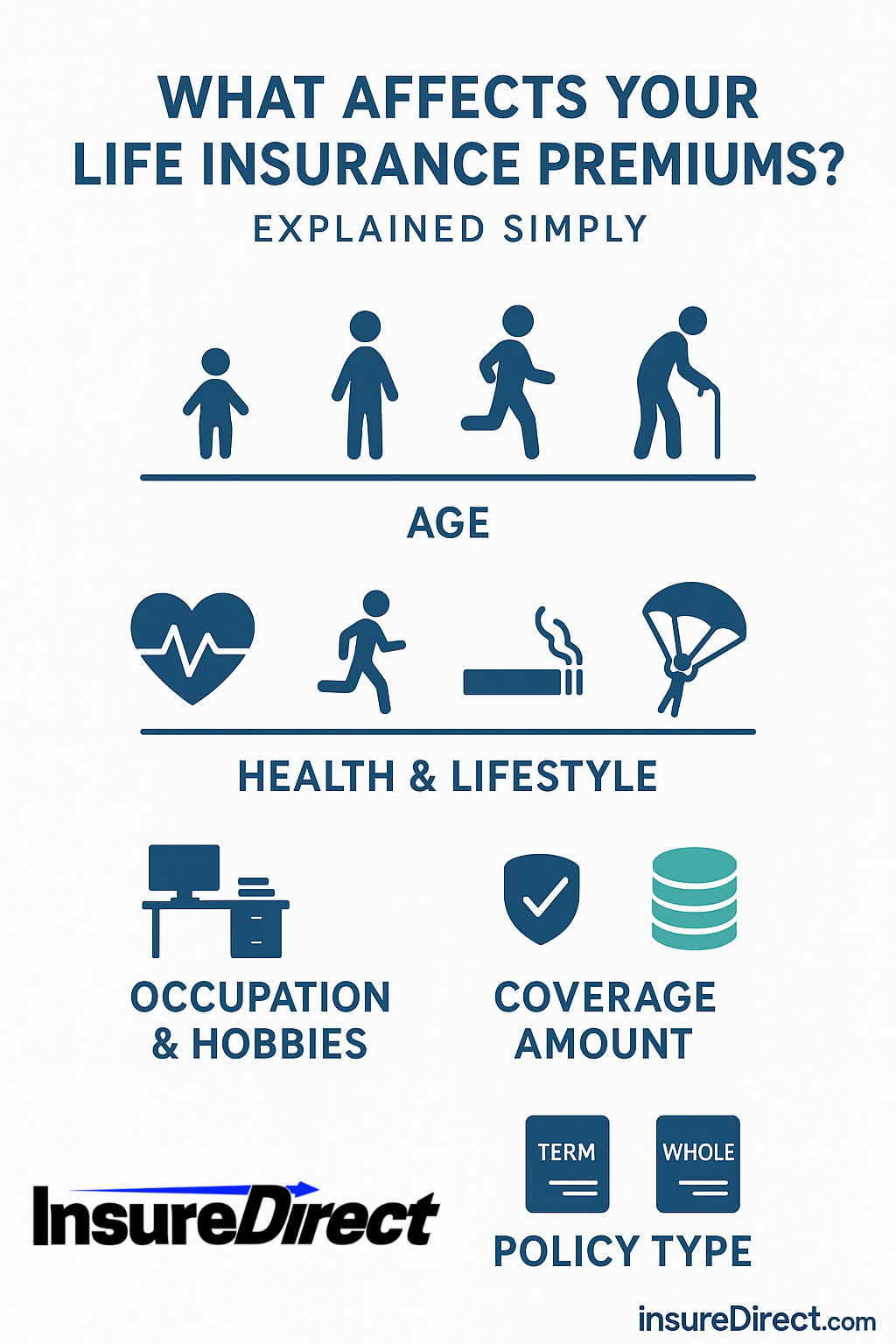
What affects life insurance premiums? Mainly your age, your health, the amount of coverage and the type of policy you choose. That is why two people can apply for the same amount on the same day and receive different prices. A premium is built from a handful of factors, and some of them you can change while others you cannot. Knowing which is which helps you plan and keeps you from paying for something you did not mean to buy.
Get a Life Insurance Quote and see what your own details produce. If you are not sure how much coverage to ask for, read how much life insurance you need.
Why Understanding Premium Factors Is Essential
1. Prices make more sense: knowing the factors explains why a friend’s quote does not predict yours.
2. You can act on some of them: the coverage amount, the policy type, and the term length are choices.
3. Honest answers matter: insurers commonly ask about health and habits, and the answers shape the price, so accuracy up front avoids trouble later.
4. Comparisons need matching details: quotes only line up when the amount, the term, and the policy type match.
Quick Facts
- Common factors: Age, health, tobacco use, coverage amount, term length or policy type
- Term vs permanent: Term premiums are generally lower than permanent coverage
- Underwriting: May include health questions, an exam, and records
- You can choose: Coverage amount, policy type, and term length
- Price: Get a quote based on your details
What Affects Life Insurance Premiums: The Factors Insurers Commonly Consider
- Age: premiums generally rise the later you start.
- Health and medical history: insurers commonly ask health questions, and some policies require an exam. See life insurance with pre-existing conditions.
- Tobacco and nicotine use: insurers commonly ask about it, and it can affect the price.
- Coverage amount: a larger death benefit generally costs more.
- Term length or policy type: the Insurance Information Institute says term premiums are generally lower than permanent coverage, because premiums go toward the death benefit rather than building savings. See term vs whole life insurance.
- Riders and extras: optional add-ons can change the premium, so ask what each one costs.
Myths About What Affects Life Insurance Premiums
Myth: Everyone your age pays the same. Health, tobacco use, coverage amount, and policy type all vary from person to person, and so does the price.
Myth: Waiting a few years makes no difference. Age is a factor, so a later start can change the premium, and health can change too.
Myth: The lowest monthly figure always means the better policy. A lower number may reflect a shorter term, a smaller amount, or a different policy type. Compare like with like.
What You Can Control and What You Cannot
Sort the factors into two groups before you ask for a quote. It shows where your choices matter.
| Factor | Can you change it? | What to do |
|---|---|---|
| Age | No | Apply sooner instead of later if you already know you need coverage |
| Health history | Mostly no | Answer every question completely and accurately |
| Tobacco use | It is your choice | Ask the insurer how it treats past and current use |
| Coverage amount | Yes | Size it with a needs analysis |
| Term length | Yes | Match it to how long people depend on you |
| Policy type | Yes | Pick term or permanent for the job you want done |
| Riders | Yes | Add only the ones you need |
Four of the seven rows are yours to decide, which is why two people of the same age can end up with very different policies.
An Everyday Example
Here is an illustration with no prices, only the reasoning. Two coworkers of the same age each ask for a quote. One wants a term policy to last until a mortgage is paid off. The other wants whole life coverage for final expenses and adds a rider.
Their quotes will not match, and neither one is being overcharged. The policy type is different, the length of coverage is different, and one policy has an extra feature. Even if they picked the identical policy, their health answers could still produce different prices. A friend’s premium tells you very little about your own.
How Underwriting Fits In
Underwriting is the insurer’s review of your application. Depending on the policy, it may include health questions, a medical exam, and a review of your records. The result can affect your price and sometimes whether a policy is offered. Some policies ask fewer questions, and they may come with trade-offs such as lower coverage amounts.
How to Compare Life Insurance Quotes Fairly
- Settle the amount first. Use the same death benefit on every quote.
- Match the policy type. Compare term with term and whole life with whole life.
- Match the term length. A 10-year term and a 30-year term are different products.
- List the riders. Check that each quote includes the same add-ons, or none.
- Give the same answers. Use the same health and tobacco answers every time, and make them accurate.
- Ask how long the premium stays level. A price that changes later is not the same as one that holds.
If the basics are new to you, start with how life insurance works.
Author’s note: A quote is only as accurate as the answers behind it. Give complete, honest answers on the application, and ask an agent about any question you are unsure about. Talk to a licensed InsureDirect agent before you apply.
Frequently Asked Questions
What affects life insurance premiums the most?
Age, health, tobacco use, coverage amount, and policy type or term length are the main factors insurers commonly consider. The weight of each varies by insurer, so a quote shows what your details produce.
Why is term life usually cheaper than whole life?
The Insurance Information Institute says term premiums are generally lower than permanent coverage because premiums go toward the death benefit rather than building savings. Permanent policies may build cash value.
Does a medical exam change the premium?
It can. Some policies require an exam, and the results can affect the price. Other policies ask fewer questions, and they typically come with trade-offs, such as lower coverage amounts.
Can I lower my life insurance premium?
Size the coverage amount with care, match the term length to the real need, and compare quotes that use the same details. Do not cut coverage below what your family needs just to lower the price.
Do riders change the premium?
Optional riders can add to the premium. Before you agree to one, ask a licensed agent what the rider does and what it adds to the price, then decide whether you need it.
Why Choose InsureDirect
Know what you can change: ask a licensed agent which of these factors you can influence and which are fixed before you apply.
More than 30 years in business: InsureDirect has worked as an independent insurance agency since 1992.
No guessing on price: what you pay depends on your own details. Request a quote online, or call (800) 807-0762 and a licensed agent will answer your questions.
Get a Life Insurance Quote and get a price for your situation.
Sources
Insurance Information Institute, What are the principal types of life insurance?. NAIC, Life insurance consumer information.
This article is for general educational purposes and is not a substitute for your policy’s actual terms and conditions. Coverage details, limits, and exclusions vary by policy and by state. Always review your specific policy documents or speak with a licensed agent before making coverage decisions.
Reviewed by Michael E. Dortch, President & Managing Agent, Combined Insurance Group, Ltd. Last updated: November 2026.
