

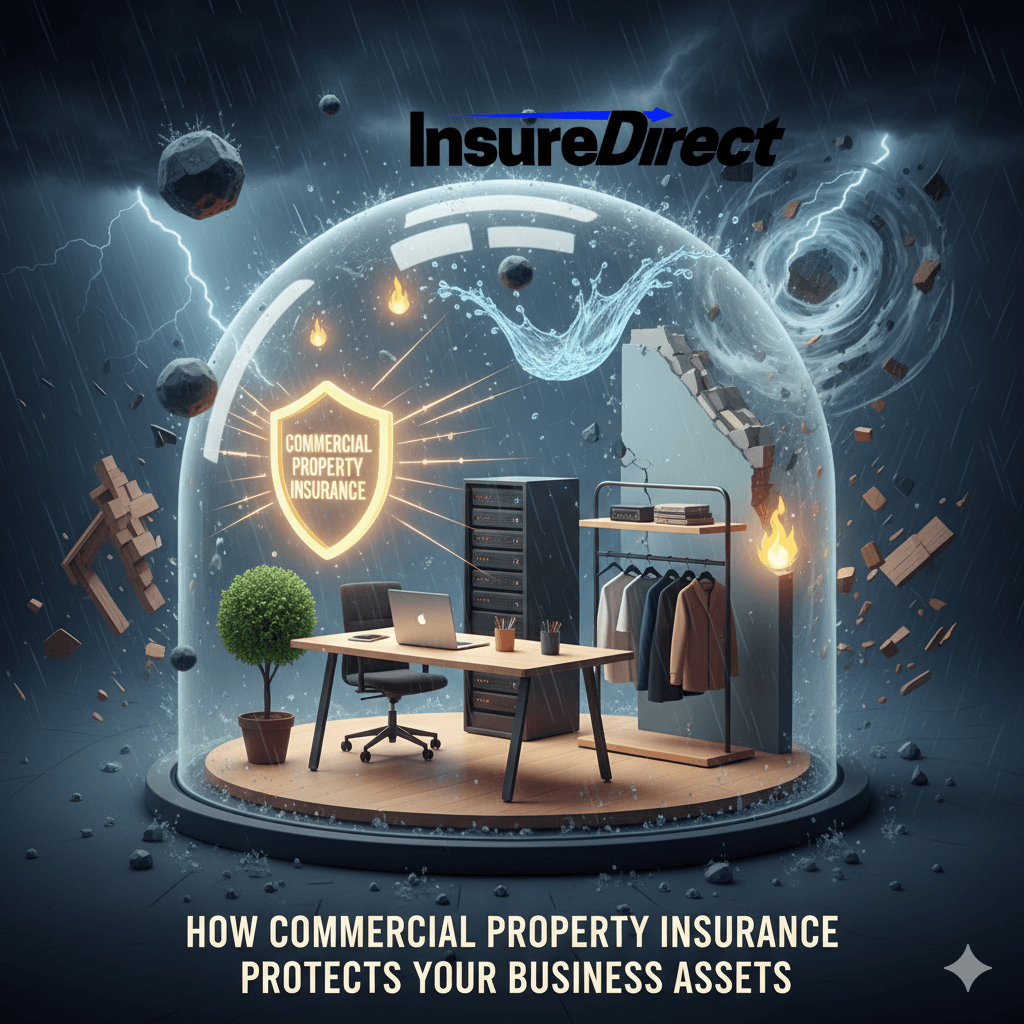
What does commercial property insurance cover? It typically covers the building, if you own it, and your business personal property, such as furniture, computers, inventory, and machinery, against perils like fire or theft. Equipment breakdown and business interruption coverage are usually added to a policy. They are not automatic.
Policies differ, so know the scope before you need it. Get a Commercial Property Quote to see what coverage for your business property would cost, then use this guide to check what is in and what is out.
| Quick Facts | Details |
|---|---|
| Typically covered | The building if you own it, plus business personal property |
| Usually added, not automatic | Equipment breakdown and business interruption |
| Depends on the policy | Debris removal and some water damage |
| Typically needs a separate policy | Flood and earthquake |
| How a loss is paid | Replacement cost or actual cash value, depending on the policy |
What Does Commercial Property Insurance Cover?
- The structure: walls, roof, floors, and permanent fixtures, if you own the building.
- Business personal property: furniture, computers, inventory, machinery, and equipment inside the space, whether you own or lease the building.
- Other items, depending on the policy: debris removal and some water damage can be included, so ask which ones your policy has.
Why Commercial Property Insurance Is Essential
1. It protects your physical investment: your building, equipment, and inventory are real capital, and one fire or storm can damage a lot of it at once.
2. It can help when a shutdown cuts income: business interruption coverage, where you have added it, can help pay operating expenses while you repair and reopen.
3. Leases and lenders may require it: some commercial landlords and lenders ask for proof of property coverage before you sign or borrow.
4. It rewards good records: an inventory and photos make a claim easier to document.
Coverage That Is Usually Added: Equipment Breakdown and Business Interruption
Two coverages come up in almost every property conversation, and neither should be assumed.
- Equipment breakdown: usually an add-on. The California Department of Insurance notes that most commercial property policies exclude losses from boilers and machinery, so a base policy may not respond when equipment fails.
- Business interruption: this can help pay operating expenses, such as rent and payroll, during the period of restoration after a covered loss. It is not automatic in every property policy. It is usually added, or bought as part of a business owner’s policy. See business interruption insurance for what it pays for.
Ask about both before you buy, and write down the answers.
Named Perils vs Open Perils
A named perils policy covers only the events it lists, such as fire, theft, or vandalism. An open perils policy covers any cause of loss unless the policy names it as an exclusion, which generally means broader coverage. Ask which type you have, since it changes how an unusual claim is treated.
What Commercial Property Insurance Does Not Cover
- Flood: flood damage typically needs a separate policy. If your property policy excludes flood, a business closed by a flood gets no business income payment, so look at flood insurance if your location could take on water.
- Earthquake: earthquake damage typically needs separate coverage as well.
- Wear and tear: wear, neglect, and poor maintenance are commonly excluded. Property insurance is meant for sudden losses such as a fire, not for upkeep.
- Undocumented income: business income coverage does not pay for income that is not documented in your financial records.
- Claims from other people: a customer’s injury or damage to someone else’s property belongs under general liability insurance, not property insurance.
- Injuries to your employees: those fall under workers’ compensation. See why workers’ compensation insurance is required.
Read the exclusions before you rely on any policy, and see why commercial property claims are denied for how they play out.
Where a Business Owner’s Policy Fits
A business owner’s policy, or BOP, packages property, liability, and business income coverage in one policy, usually for small and medium businesses. Its limits are usually lower, so ask whether they fit your property. Workers’ compensation, business vehicles, and professional liability stay separate from a BOP.
What Does Commercial Property Insurance Cover in a Real Loss?
Picture a small restaurant with a kitchen fire. Beyond the deductible, the property policy typically pays to replace damaged equipment and inventory, and to repair the building if the restaurant owns it, up to the policy limit. If the owner added business interruption coverage, that can also help pay rent and payroll while the restaurant is closed. If not, those weeks come out of the owner’s pocket.
How a Loss Is Valued
Policies can pay actual cash value, which subtracts depreciation, or replacement cost, which pays what it costs to replace an item with a new one. For equipment that loses value quickly, that difference can change the payout, so ask which your policy uses.
The insured amount matters just as much. Insuring for purchase price or book value can leave a gap, because on a replacement cost policy a loss is measured by what it costs to rebuild or replace today, and those costs change over time. Review the amount regularly, and see how to value your business property for a method.
What Drives the Cost of Commercial Property Insurance
There is no standard price. Cost depends on the details of your property and on the choices you make. The main drivers:
- The building: the California Department of Insurance says building rates are based on factors that include square footage, type of construction, whether the building has sprinklers, and its fire protection classification.
- How much you insure: the limit is meant to reflect what it would cost to rebuild and replace, so more property means more coverage to pay for.
- Your deductible: a higher deductible generally means a lower premium, and more out of your own pocket on a loss.
- The valuation method: replacement cost and actual cash value pay differently, and the choice can affect the premium.
- What you add: equipment breakdown, business interruption, and other endorsements each change the price.
- Your loss history: premium costs tend to come down as a business’s loss experience improves.
The way to know your own number is to get a quote built on your details.
Myths About Commercial Property Insurance
Myth: Commercial property insurance only covers the building. It typically covers business personal property too, including property you own inside a space you lease.
Myth: Business interruption coverage comes with every property policy. It is not automatic. It is usually added to the policy or bought within a business owner’s policy, so ask before you assume.
Myth: A property policy covers any damage to the building. A policy covers the causes of loss it lists, or every cause except the ones it excludes. Flood and earthquake typically need separate coverage.
Frequently Asked Questions
Do I need commercial property insurance if I lease my space?
You typically need coverage for your own property. Your equipment, furniture, and inventory are yours even in a leased space, and a property policy can cover them. Who insures the building depends on your lease, so read it.
Does commercial property insurance cover lost income during a shutdown?
Only if you have business interruption coverage, also called business income coverage, and the shutdown comes from a covered loss. It is not automatic in every property policy. It is usually added, or bought as part of a business owner’s policy, so ask before you rely on it.
What is the difference between named perils and open perils coverage?
A named perils policy covers only the events it lists. An open perils policy covers any cause of loss that is not specifically excluded, which generally means broader protection. Ask which type you have before you need to use it.
Is commercial property insurance the same as general liability?
No. Property insurance covers your own building and business property, while general liability covers claims from other people, such as bodily injury or property damage to a third party. The general liability insurance page explains that side.
How much does commercial property insurance cost?
There is no single price. Cost depends on your building, the value you insure, your deductible, the valuation method, and the coverages you add. The way to know is to get a quote built on your own details.
What should I keep on hand to make a property claim easier?
Keep an inventory, photos, and purchase records somewhere off-site, and review insured values once a year. Income that is not documented in financial records is not covered, so keep those records current.
Author’s note: Before you buy or renew, ask three questions: is business interruption coverage included, is equipment breakdown included, and what does the policy exclude? Write the answers down. If you have questions about them, talk to a licensed InsureDirect agent.
Why Choose InsureDirect
Property questions answered: a licensed InsureDirect agent can answer questions about what a commercial property policy includes and leaves out, by phone or online.
Since 1992: InsureDirect has been an independent insurance agency for more than 30 years.
A real price for your situation: cost depends on your details, so there is no one number that fits everyone. Get a quote built around yours, or call (800) 807-0762 to talk with a licensed agent.
Get a Commercial Property Quote and see what coverage for your business property would cost.
Sources
Insurance Information Institute, Small business insurance basics. Insurance Information Institute, Do I need business interruption insurance? and Understanding business owners policies (BOPs). California Department of Insurance, Commercial Insurance Guide.
This article is for general educational purposes and is not a substitute for your policy’s actual terms and conditions. Coverage details, limits, and exclusions vary by policy and by state. Always review your specific policy documents or speak with a licensed agent before making coverage decisions.
Reviewed by Michael E. Dortch, President & Managing Agent, Combined Insurance Group, Ltd. Last updated: November 2026.
