

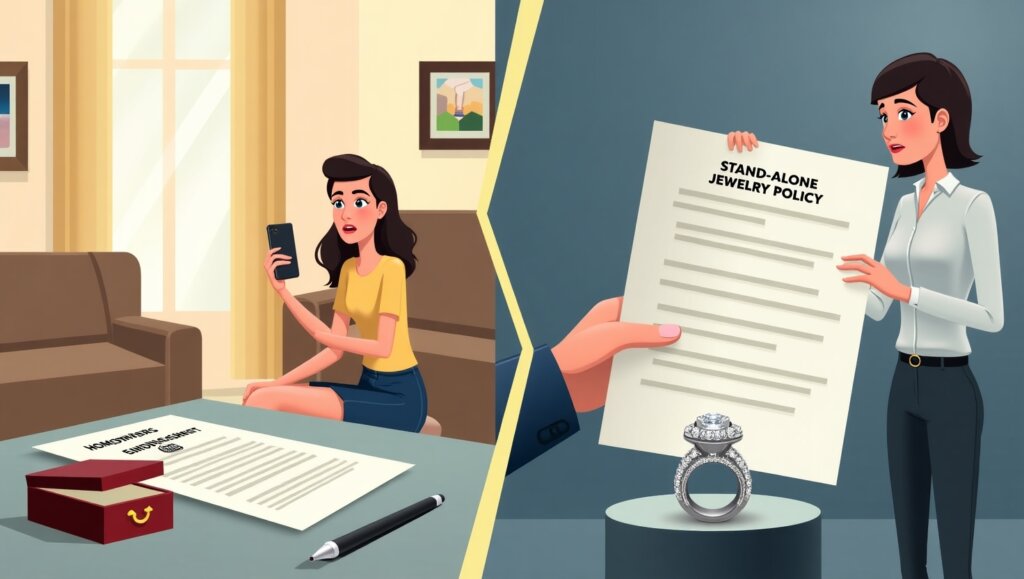
Stand-alone jewelry insurance is a separate policy written only for your jewelry. A home endorsement adds jewelry coverage to the homeowners policy you already have. Both can give your pieces more protection than a standard homeowners policy offers, and neither is right for everyone.
The names vary, with endorsement, rider, floater, and schedule used loosely, so the written terms matter more than the label. Get a Jewelry Insurance Quote to price the pieces you want to protect, or call (800) 807-0762 with questions.
| Quick Facts | Details |
|---|---|
| Homeowners theft limit | Generally about $1,500 |
| Raised limit | Costs less, capped per item and overall |
| Scheduled floater | Costs more, broadest protection |
| Required before a floater | Professional appraisal |
| How to compare | Written terms, line by line |
The Two Ways to Upgrade Jewelry Coverage
The Insurance Information Institute describes two upgrades: raise the limit, or buy a floater and schedule your pieces. Insurers write these as an endorsement or a separate policy. Raising the limit costs less but stays capped per item and overall, and the Institute’s example is a $2,000 limit per piece with a $5,000 overall limit. A floater with scheduled items costs more and offers the broadest protection, including accidental loss.
Why Comparing These Two Options Is Essential
1. Homeowners limits are low for jewelry: the Insurance Information Institute says theft of jewelry generally carries a sublimit of about $1,500.
2. Scheduling means appraisals: items must be professionally appraised before a floater is purchased.
3. One label can hide different terms: endorsement, rider, floater, and schedule are used loosely, so read the policy text.
4. Your home policy can affect the choice: an endorsement is part of the home policy, so changes to that policy may change the jewelry coverage.
Stand-Alone Jewelry Insurance vs a Home Endorsement at a Glance
| Point | Home endorsement | Stand-alone policy |
|---|---|---|
| What it is | A change to your homeowners policy | A separate contract written for jewelry |
| Who insures it | Your home insurer | The insurer that writes the jewelry policy |
| Tied to the home policy | Yes | May not be, so ask |
| Form it takes | A raised limit or a schedule of items | Depends on the insurer |
| Deductible and limits | As written in the endorsement | As written in the policy |
| Appraisal | Required before items are scheduled on a floater | Ask what the insurer requires |
The table shows how the two are built. It cannot tell you which one covers more, because that comes from the written terms of the exact policies you are offered.
How a Home Endorsement Works
An endorsement changes your homeowners policy. It can raise the limit on jewelry or add a schedule of specific items.
Because the coverage lives inside the homeowners policy, you deal with one insurer and one policy. Ask whether a deductible applies to a jewelry loss, which the guide to homeowners insurance deductibles helps you weigh, and ask what happens to the jewelry coverage if the home policy changes.
How Stand-Alone Jewelry Insurance Works
A stand-alone policy is a separate contract written for jewelry. Because it is separate, it may not depend on a homeowners policy, which can matter for renters, for people who switch home insurers, or for anyone who wants terms written around jewelry. Terms differ by insurer, so ask about each point in the line-by-line list below.
Renters have one more reason to look closely. A landlord’s policy is not written for a tenant’s valuables, as covered in whether landlord insurance covers renters’ belongings, so the jewelry has to be protected by the renter’s own coverage.
Blanket Jewelry Coverage vs Scheduled Coverage
A second choice sits inside the first one. Whichever way you buy, the pieces can be covered as a group or one by one. People often search for this as blanket jewelry coverage vs scheduled.
- Blanket coverage: the usual name for one overall limit that covers a group of pieces without listing each one, typically with a cap on any single piece. The Institute’s raised-limit example, $2,000 per piece and $5,000 overall, works this way.
- Scheduled coverage: each piece is listed on its own after a professional appraisal. The Institute says a floater with scheduled items costs more and offers the broadest protection.
Insurers do not all use the word blanket the same way. Ask for the cap per piece, the overall limit, and whether appraisals are needed. As a rough guide, a few high-value pieces point toward scheduling, while a collection of modest pieces that each fit under the per-piece cap may suit a blanket limit.
How to Compare Them Line by Line
- What is covered: theft, fire, accidental loss, and unexplained loss, as written. Unexplained loss is where wording varies most from policy to policy.
- Limits: the amount per item and the overall amount.
- Deductible: whether one applies and how large it is.
- Settlement: whether a loss is paid by replacement, repair, or a cash amount.
- Where it applies: at home, away from home, and while traveling.
- Documents: the appraisals, receipts, and inventory the insurer expects.
Ask for each answer in writing and lay the two options side by side. The loss wording deserves the closest read, so see whether jewelry insurance covers lost jewelry.
Which Option Fits Your Situation
Neither option wins for everyone. These questions point the way:
- How many pieces, and how valuable? Ask each insurer to quote your pieces both ways.
- Do you plan to keep your homeowners policy? If you may switch insurers or move, ask how each option would carry over.
- Do you own or rent? Renters can ask the same questions about a stand-alone policy.
Get a quote for each and compare the written terms. For the steps that apply to either path, see how to insure valuable jewelry.
Frequently Asked Questions
What is the difference between a jewelry endorsement and a stand-alone policy?
An endorsement adds jewelry coverage to your homeowners policy, while a stand-alone policy is a separate contract written for jewelry. Terms vary by insurer, so compare limits, deductibles, and exclusions in the actual policy text.
Is a jewelry floater the same as scheduled coverage?
The terms are often used together. A floater with scheduled items lists each piece separately after a professional appraisal, and the Insurance Information Institute says it costs more than raising the limit and offers the broadest protection.
Does stand-alone jewelry insurance cost more than an endorsement?
That depends on the pieces, their values, and the insurer, so there is no one-size answer. Get a quote for each option and compare the terms, not only the price. A lower price with a tighter cap per piece may not be the better deal.
Do I need a homeowners policy to buy a stand-alone jewelry policy?
Ask the insurer. A stand-alone policy is a separate contract, so it may not depend on a homeowners policy, but eligibility rules differ by insurer. Renters can ask the same question about their renters policy.
What is the difference between blanket and scheduled jewelry coverage?
Blanket coverage usually means one overall limit for a group of pieces, with a cap on any single piece. Scheduled coverage lists each piece separately after an appraisal. Insurers use the terms differently, so ask for the cap per piece and the overall limit in writing.
Which option fits an engagement ring?
Either can work. The deciding factors are the ring’s appraised value, whether other pieces also need protection, and the written terms of each policy. For the questions to ask, see wedding ring and engagement ring insurance.
Myths About Jewelry Coverage Options
Myth: Stand-alone jewelry insurance is always better than an endorsement. Neither is better for everyone. The right choice depends on the pieces, the policy terms, and your situation.
Myth: An endorsement gives you complete coverage automatically. Raising a limit is still capped per item and overall, and it is not the same as scheduling each piece.
Myth: Endorsement, rider, and floater all mean the same thing. The words are often used loosely. What matters is what the written terms say about limits, scheduling, loss, and deductibles.
Author’s note: Ask every insurer the same list of questions and write the answers down. If you have questions about either option, talk to a licensed agent with your appraisals in hand.
Why Choose InsureDirect
Answers on both options: a licensed agent can answer questions about an endorsement and a stand-alone policy for the same pieces.
An independent agency: InsureDirect has been getting families and businesses covered since 1992.
A quote based on your details: the price depends on your own situation, so the only way to know it is to ask. Get a quote, or call (800) 807-0762 to talk with a licensed agent.
Get a Jewelry Insurance Quote and get a price built around your pieces.
Sources
Insurance Information Institute, Special coverage for jewelry and other valuables.
This article is for general educational purposes and is not a substitute for your policy’s actual terms and conditions. Coverage details, limits, and exclusions vary by policy and by state. Always review your specific policy documents or speak with a licensed agent before making coverage decisions.
Reviewed by Michael E. Dortch, President & Managing Agent, Combined Insurance Group, Ltd. Last updated: November 2026.
