

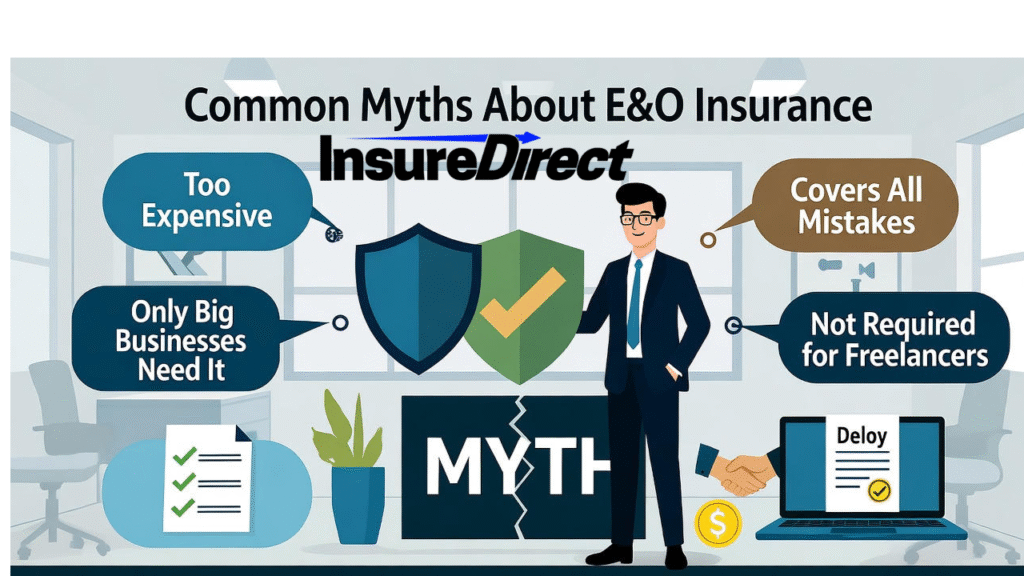
Professionals who go without errors and omissions (E&O) insurance are often not careless. They believe something that sounds reasonable and turns out to be wrong. The E&O insurance myths below come up again and again, and each one can leave a gap that only shows itself when a client sends a demand letter.
Read the eight myths and the facts behind them. If one sounds familiar, Get Instant Coverage to see what a policy would look like for your work. If you sell life or health insurance, the E&O plan for life and health agents is the page built for your profession.
| Quick Facts | Details |
|---|---|
| Myth to clear up | General liability covers professional mistakes |
| Fastest fix | Get coverage before a claim, not after |
| Starting price | $21.05 a month or $252.60 a year |
| Limits | $1M per claim and $3M aggregate |
| Generally excluded | Intentional or dishonest acts, and non-financial losses |
E&O Insurance Myths About Who Needs Coverage
Myth: Small businesses do not get sued. Size does not decide whether a client can bring a claim. A solo professional or sole proprietor who gives advice or provides a service for a fee can receive one, and the legal bills do not shrink because the business is small.
Myth: E&O only helps if you actually made a mistake. A claim is an allegation, not a verdict. A client can say a mistake or a missed detail cost them money even when your work was sound, and the legal bills start either way. Professional liability coverage typically pays legal defense costs for covered claims, even when the claim has no merit, beyond your deductible and up to the policy limit. Good work lowers the odds of a claim. It does not remove them.
Myth: E&O is only for doctors and lawyers. Some states require professional liability for professions such as attorneys and doctors, who need malpractice policies written for them. The list of people who should consider E&O is far longer. The Insurance Information Institute names accountants, architects, engineers, graphic designers, IT consultants, insurance professionals, investment advisors, management consultants, real estate agents and brokers, and software developers, and says the list is not exhaustive.
Myths About What E&O Covers and Costs
Myth: A general liability or business owner’s policy already covers your mistakes. General liability handles injury and property damage to other people. The Insurance Information Institute notes that professional liability covers claims general liability does not, such as negligence and inaccurate advice, and that it is not included in a business owner’s policy. See E&O vs general liability for the side-by-side.
Myth: An LLC protects everything. A limited liability company or similar entity may limit personal exposure in some situations, but it does not supply money to hire a lawyer or settle a claim, and it may not protect you from claims about your own professional work. Ask your attorney how your entity is treated in your state.
Myth: E&O is too expensive for a small business. Through InsureDirect, E&O starts at $21.05 a month or $252.60 a year, with no down payment. Your final price depends on your profession, revenue and limit. See how much E&O insurance costs for what moves the number.
Myths About Timing and Paperwork
Myth: A policy can be bought after a client complains. You can buy a policy after a complaint, but it will not cover a claim or a problem you already knew about. E&O is usually written on a claims-made basis. That means the policy must be active when the claim is made, and the incident must have happened on or after the retroactive date. The E&O retroactive date post explains how far back coverage can reach.
Myth: A contract clause or disclaimer is enough. A well-drafted contract defines your scope and can reduce disputes. It does not stop a client from filing a claim, and it does not pay your lawyer. Have an attorney review your wording, and treat insurance as the backup for when the paperwork is not enough.
What to Do With This Information
Knowing the E&O insurance myths only helps if you act on it. Five steps cover most of the gaps above.
- Read your client contracts: look for an insurance clause that names a minimum limit or asks for a certificate.
- Write down your scope of work: put deliverables, timelines and exclusions in writing for every project.
- Check your policy terms: find the claims-made wording, the retroactive date and the exclusions. Intentional or dishonest acts, and losses that are not financial, are generally excluded. The full list is in what E&O insurance covers.
- Learn where disputes start: read common E&O claims and how to prevent them and compare it with your own habits.
- Decide with the facts: if you are still unsure whether you need a policy, read do you need E&O insurance before you decide.
Why Busting These E&O Insurance Myths Is Essential
1. A wrong belief becomes a coverage gap: you cannot fix a gap you do not know about, and a gap often shows up only when a claim arrives.
2. Defense costs arrive early: a lawyer is needed to answer a claim long before anyone decides who is right, even when the claim has no merit.
3. Clients are paying attention: many client contracts ask for proof of coverage before the work begins, so a gap can cost you a job as well as a claim.
4. The fix is simple: you can get a quote online, and there is no down payment on an InsureDirect E&O plan.
Author’s note: If one of these myths sounded like you, you are in good company. Pull out your newest client contract, read the insurance clause, and then talk to a licensed agent if you have questions about limits or terms.
Frequently Asked Questions
Do I need E&O if I already have general liability?
Often yes. General liability responds to injury and property damage claims from other people, while E&O responds to claims that your professional work caused a financial loss. Many professionals carry both because each one covers risks the other does not.
Is E&O insurance required by law?
Some states require professional liability for certain professions, such as attorneys and doctors, who need malpractice policies written for them. Rules vary by profession and by state. Even where no law applies, clients, brokerages and carriers may ask for proof of coverage, so check your contracts and your state’s rules.
Does E&O cover intentional or dishonest acts?
Generally not. Policies typically exclude intentional or dishonest acts, along with losses that are not financial, such as bodily injury. Read the exclusions section of your policy so you know exactly where those lines sit before you rely on it.
Can I buy E&O after a client complains?
You can buy a policy, but it will not cover a claim or a problem you already knew about. Most E&O policies are claims-made, so the policy must be active when the claim is made. Buying before a problem appears is the way to have a policy in place when one does.
Is E&O the same as professional liability insurance?
Usually, yes. E&O, or errors and omissions, is also called professional liability, and both names describe coverage for claims that your professional work caused a client a financial loss. Policy wording, not the name, decides what is covered, and the guide to professional liability vs E&O explains how the terms are used.
How much does E&O insurance cost?
E&O through InsureDirect starts at $21.05 a month or $252.60 a year, with no down payment and $1M per claim and $3M aggregate limits. A quote shows the exact number for your profession, revenue and limit.
Why Choose InsureDirect
Transparent pricing: E&O plans start at $21.05 a month or $252.60 a year, with no down payment and zero hidden fees.
Limits: $1M per claim and $3M aggregate.
Carrier: ERGO Next Insurance.
Rated: A+ (Superior) rating from AM Best.
Answers before a claim arrives: a licensed InsureDirect agent can answer your questions about E&O by phone or online, before a client letter forces the issue.
Get Instant Coverage and see what E&O costs for your kind of work.
Sources
Insurance Information Institute, Professional liability insurance. Insurance Information Institute, Understanding business owners policies (BOPs).
This article is for general educational purposes and is not a substitute for your policy’s actual terms and conditions. Coverage details, limits, and exclusions vary by policy and by state. Always review your specific policy documents or speak with a licensed agent before making coverage decisions.
Reviewed by Michael E. Dortch, President & Managing Agent, Combined Insurance Group, Ltd. Last updated: November 2026.
