

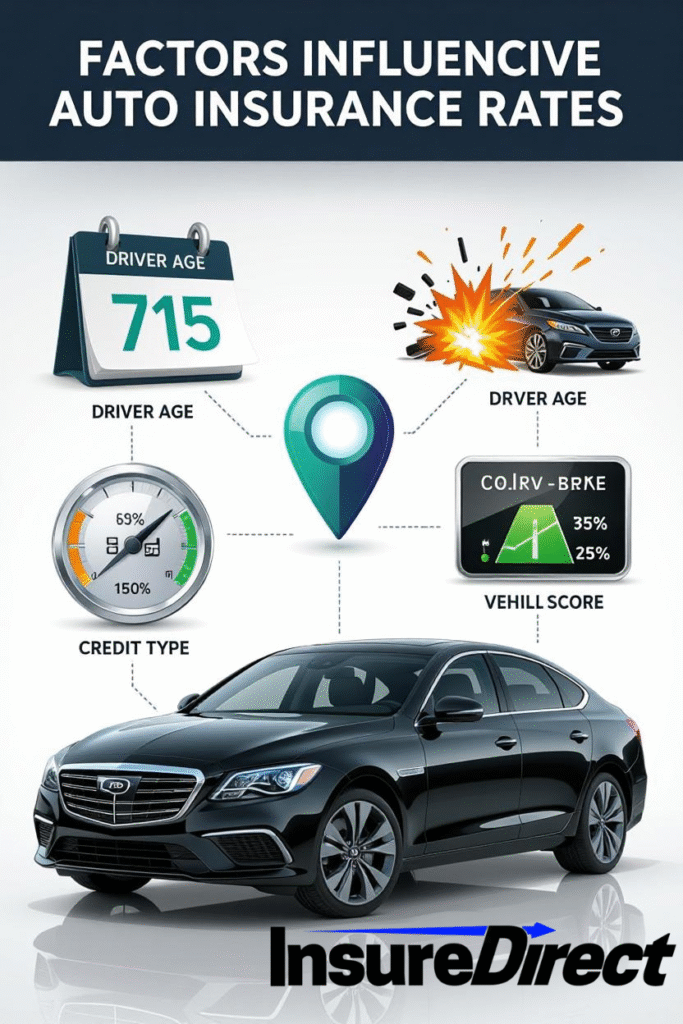
What affects your car insurance rate? It comes down to five things: who drives, what you drive, where the car is kept, how it is used, and the coverage you choose. Insurers weigh those factors differently, which is why the same driver can see two different prices.
Knowing the factors helps you change what you can and read a quote with confidence. Get a Car Insurance Quote to see a price built on your own details, or read on to see each factor in plain terms.
Why Knowing What Affects Your Car Insurance Rate Is Essential
1. Some factors are in your hands: coverage amounts, deductibles, and driving habits are choices you control, and each one can change the price.
2. Quotes make more sense: when you know why a price moved, you can tell a fair quote from one that quietly cuts coverage.
3. Fewer renewal surprises: a change in your household, your car, or your mileage can show up on the next bill, and you will know where to look.
4. Better quote requests: knowing the factors helps you gather the right details before you ask for a quote.
Quick Facts
- What sets your rate: The driver, the car, where it is kept, how it is used, and the coverage you choose
- Who decides the weight of each factor: Each insurer, within state law
- What you control: Coverage amounts, coverage types, deductible, and driving habits
- Price: Depends on your details, so a quote is the only way to know
Factors About the Driver and the Household
Insurers commonly look at the items below. How much weight each one gets differs by insurer and by state.
- Driving record: accidents and violations tell an insurer how likely a future claim may be.
- Age and experience: newer and younger drivers are often rated differently from experienced ones. For more on younger drivers, read teen driver car insurance.
- Claims history: earlier claims can affect the price, depending on the insurer, the type of claim, and who was at fault. The process itself is covered in how to file a car insurance claim.
- Number of drivers: every licensed driver in the household is one more driver to price.
- Continuous coverage: some insurers look at gaps between policies. A gap also carries legal risk, as what happens if you drive without car insurance explains.
- Credit-based insurance score: some insurers use one where state law allows it, and the rules differ from state to state.
Factors About the Car and Where It Is Kept
- The vehicle: repair costs, safety features, and how often that model is claimed on or stolen all play a part.
- Location: traffic, theft, and weather claims in your area affect pricing, which is why a move can change your rate.
- Use and mileage: a long daily commute carries more exposure than a car that sits in the driveway most days.
In plain terms, insurers look at how drivers, cars, and places like yours have performed in the past.
Factors You Choose Yourself
Coverage is the part of the price you control most directly. The Insurance Information Institute names the amount of coverage and the types of coverage chosen as two of the things that determine what you pay.
- Liability limits: higher limits generally cost more and protect more of your savings if you cause a serious accident.
- Optional coverages: collision, comprehensive, and add-ons raise the price along with the protection. For what each one does, see types of car insurance coverage.
- Deductible: a higher deductible usually lowers the premium, but you pay more out of pocket when you file a claim. Pick an amount you could pay without strain.
What Affects Your Car Insurance Rate That You Can Change?
Some factors move only with time. Others respond to a decision you make this week. The table sorts them.
| Factor | Can you change it? | How |
|---|---|---|
| Coverage types and limits | Yes | Choose them on purpose, not by default |
| Deductible | Yes | Pick an amount you could pay from savings |
| Annual mileage | Sometimes | Keep the figure on your policy current |
| Vehicle | When you buy | Ask for a quote before you commit to a car |
| Driving record | Over time | Avoid tickets and at-fault accidents |
| Age and experience | No | They change only with time |
| Location | Rarely | A move can change the price in either direction |
Cutting coverage is the fastest way to lower a price and the easiest one to regret. Lower a limit or drop a coverage only when you know what you would pay yourself after a claim.
Why Your State Matters
Car insurance is regulated state by state, and that shapes your rate in three ways.
- Minimum limits: each state sets its own minimum liability limits, so the starting point for a legal policy differs.
- Rating rules: rates must follow the laws of the state where the policy is sold, including which factors an insurer may use. A credit-based insurance score is one example, since it is used only where state law allows it.
- Required coverages: some states require coverages that are optional elsewhere. Uninsured motorist coverage is mandatory in about 20 jurisdictions, and elsewhere insurers must offer it but you may decline.
For the rules where you live, check with your state insurance department.
Why Two Insurers Quote Different Prices
Premiums are calculated using many factors, and some insurers give certain factors more weight than others. Rates must also follow the laws of the state where the policy is sold. So two companies can look at the same driver and reach different numbers. That is normal, and it is the reason comparing matters, as long as the quotes use the same limits and deductibles. See how to compare car insurance quotes for how to line them up fairly.
What to Do Before Your Next Renewal
1. Find your declarations page: it lists your drivers, vehicles, limits, and deductibles.
2. Update what has changed: a shorter commute, a driver who moved out, or a car you sold.
3. Decide your coverage first: write down the limits and deductibles you want before you look at any price.
4. Ask about discounts: they differ by insurer and state, so ask which ones apply to you.
5. Get a fresh quote: a quote on your current details shows whether the renewal price still makes sense.
Myths About Car Insurance Rates
Myth: Every insurer prices the same driver the same way. Each insurer weighs the factors differently and sets its own rates within state rules, so prices can differ from one company to the next.
Myth: Your rate can only change if you have an accident. Renewal prices can also move when your coverage, mileage, vehicle, or household drivers change, or when an insurer adjusts its own rates.
Myth: Car color changes the price. Color is not a standard rating factor. Insurers look at the make, model, age, repair cost, and safety features of the car instead.
Frequently Asked Questions
How is a car insurance rate calculated?
Insurers use many rating factors, including the driver, the vehicle, where it is kept, how it is used, and the coverage chosen. Each insurer weighs them differently and follows the rules of the state where the policy is sold, so prices vary from company to company.
Does my driving record affect my car insurance rate?
In most cases, yes. Accidents and violations point to a higher chance of a future claim, so insurers commonly factor them in. How much weight a record carries depends on the insurer and the state, so it is one piece of a larger picture.
Why did my rate go up when I did not have an accident?
Renewal prices can move for reasons beyond your own driving. Changes in coverage, mileage, vehicles, or household drivers can matter, and so can changes in the insurer’s own rates. Ask your agent what changed at renewal.
Does a higher deductible lower my premium?
Usually it does, because you agree to pay more of a loss yourself. The trade-off is a larger bill when you file a claim. Pick a deductible you could cover from savings without strain, and check how it applies to each coverage on your policy.
Can I bring my car insurance rate down?
Often, yes. You can compare quotes with matching coverage, review your limits and deductibles, ask which discounts apply to you, keep your mileage details current, and protect your driving record. Discounts differ by insurer and state, so ask what is available.
Author’s note: Rating rules differ by state and by insurer, so a quote built on your real details is the clearest way to see what applies to you. Talk to a licensed InsureDirect agent if you have questions about it.
Why Choose InsureDirect
Start with your details: a quote is built on your real driver, car, and location.
Since 1992: InsureDirect has been an independent insurance agency for more than 30 years.
No guessing on price: what you pay depends on your own details. Request a quote online, or call (800) 807-0762 and a licensed agent will answer your questions.
Get a Car Insurance Quote and see a price built around your driver, car, and location.
Sources
Insurance Information Institute, What determines the cost of my auto insurance? and Background on: Compulsory auto/uninsured motorists.
This article is for general educational purposes and is not a substitute for your policy’s actual terms and conditions. Coverage details, limits, and exclusions vary by policy and by state. Always review your specific policy documents or speak with a licensed agent before making coverage decisions.
Reviewed by Michael E. Dortch, President & Managing Agent, Combined Insurance Group, Ltd. Last updated: November 2026.
