

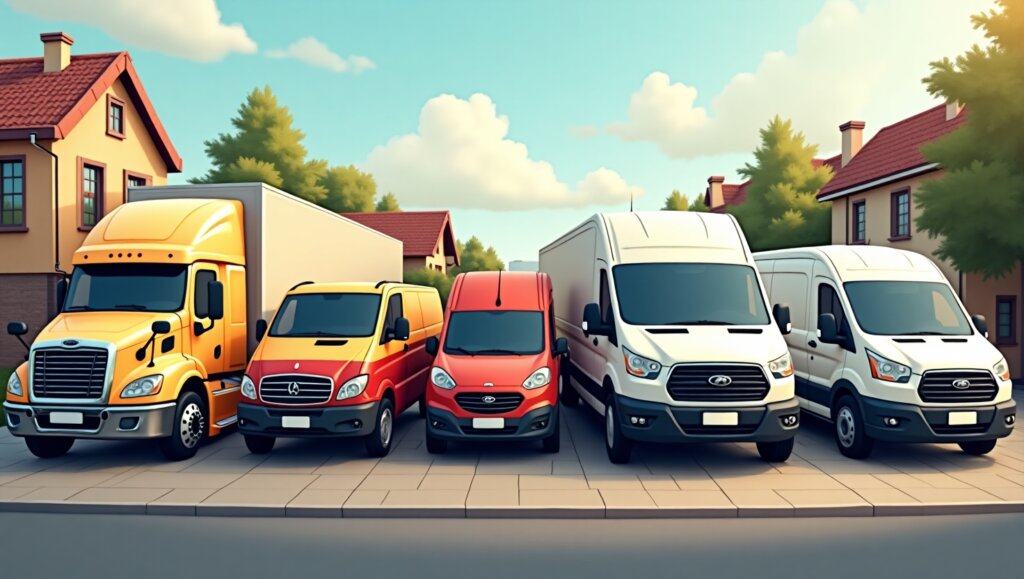
Two businesses can each own one pickup and still need very different coverage. A roofer hauls ladders and materials between job sites. A courier makes dozens of stops a day. A sales rep drives a personal car to client meetings. That is why commercial vehicle insurance by industry looks a little different each time: the coverage follows how, where, and why a vehicle is used.
When you are ready for a price, Get a Commercial Auto Quote and tell an agent how your vehicles are used. If you are new to the topic, start with what commercial auto insurance is.
Commercial Vehicle Insurance by Industry: How Each Trade Uses Vehicles
- Contractors, landscapers, and trades: work trucks and trailers move people, tools, and materials. Ask whether trailers and the equipment kept in the vehicle are covered, since vehicle coverage and equipment coverage are often separate.
- Delivery and courier businesses: many stops and many miles raise the chance of a collision. Ask how the policy treats drivers who use their own vehicles.
- Trucking and hauling: rules vary by state, so confirm what applies to you with your state agency and an agent. Ask whether cargo coverage is included, since coverage for hauled goods is often a separate question.
- Sales, service, and field teams: employees often drive their own cars to visit customers. That is where hired and non-owned auto liability comes in.
- Restaurants, caterers, and food delivery: a catering van owned by the business is one question, and staff delivering orders in their own cars is another. Ask about both.
- Real estate, consulting, and professional offices: the business may own no vehicle at all, yet people drive to showings, client sites, and the bank. Rented cars on business trips belong in the same conversation.
- Cleaning and other mobile services: crews travel between customers all day, sometimes in a company van and sometimes in personal cars. Ask how each arrangement is treated.
A Worked Example: One Pickup, Two Businesses
A landscaper and a consultant each drive the same model of pickup. This is an illustration of how use changes the answer.
The landscaper’s truck is titled to the business, pulls a trailer, carries mowers, and is driven by two employees. It belongs on a commercial auto policy, with questions about the trailer, the equipment, and each driver.
The consultant’s truck is titled personally and used mostly for family driving, with some client visits. A personal policy may cover some business use, so the first step is to tell the insurer exactly how the truck is used and ask whether that use is covered.
Same truck, two different answers, because the use is different.
The Coverages That Come Up Most
- Liability: every industry needs it. Many insurers recommend a $1 million limit, with $500,000 as a minimum.
- Physical damage: collision and comprehensive on vehicles the business owns, paid at actual cash value. It matters most for newer trucks and vans the business could not easily replace.
- Hired and non-owned auto liability: for sales teams, offices, restaurants, and any business whose people drive their own cars or rent vehicles for work.
- Cargo and equipment coverage: for haulers, couriers, and trades. Goods you carry and tools kept in the vehicle are often insured separately from the vehicle itself.
Questions to Ask Before You Buy
- Who drives? Employees, owners, and subcontractors are not always treated the same way.
- Which vehicles are involved? Owned, leased, rented, and borrowed vehicles raise different questions.
- How far and how often? Insurers commonly ask how far vehicles travel, where they are kept, and what they carry.
- What limit fits your contracts? See how to choose commercial auto liability limits.
- Who is the principal insured? On a business-owned vehicle, list the business, not yourself personally.
What Shapes the Price and How Auto Fits With Other Coverage
Vehicle type, driver records, use, limits, and claims history can all move a quote. To see each one, read what affects commercial auto insurance cost. The only reliable way to know your own number is to get a quote.
Commercial auto answers for accidents involving your vehicles. General liability insurance is a separate policy for claims tied to your operations and premises. A personal umbrella policy typically excludes business claims, so do not count on one for a work vehicle accident.
Why Commercial Vehicle Insurance by Industry Matters
1. Personal policies often stop short: a personal auto policy may cover some business use, but a vehicle used mainly for business, or owned by a business, likely is not covered by it.
2. Exposures differ by trade: a delivery route and a work truck parked at a job site carry different risks, and the policy should reflect the one you actually have.
3. Clients may ask for proof: customers, landlords, and general contractors may want to see proof of coverage before you start work.
4. Gaps are cheaper to fix before a claim: it is far easier to change a quote than to discover a gap after an accident.
| Quick Facts | Details |
|---|---|
| Main question | How, where, and why each vehicle is used |
| Personal auto policy | May not cover vehicles used mainly for business or owned by a business |
| Employees using their own cars | Ask about hired and non-owned auto liability |
| Cargo and equipment | Often a separate coverage question |
| Price | Get a quote built on vehicles, drivers, and use |
Frequently Asked Questions
Does commercial vehicle insurance differ by industry?
The core policy is similar, but the details change with the work. A contractor, a courier, and a sales team each ask different questions about equipment, cargo, drivers, and who owns the vehicle. The price differs as well, because the use differs.
Do I need commercial auto insurance for just one work truck?
Possibly. A vehicle owned by a business, or used mainly for business, likely is not covered under a personal policy. Tell an agent how the truck is used, who drives it, and whose name is on the title, and ask which policy fits.
Is cargo covered under commercial auto liability?
Coverage for goods you haul is often a separate question from vehicle liability. Ask whether cargo coverage is included, what it pays, and whether your type of cargo is covered. The same goes for tools and equipment kept in the vehicle.
What if employees drive their own cars for work?
The business can still face a claim, even though it does not own the car. Hired and non-owned auto liability is designed for that situation and typically sits above the employee’s own personal auto limits, which are used first. Ask an agent how it would apply to your team.
Are there legal requirements for commercial vehicles?
Rules vary by state, so there is no single answer for every business. Confirm what applies to your vehicles with your state agency and a licensed agent before you buy. Client contracts can set their own requirements on top of the law, so read those too.
Myths About Commercial Vehicle Insurance
Myth: Your personal auto policy covers your work truck. The Insurance Information Institute notes that a vehicle used primarily for business, or owned by a business, likely is not covered under a personal policy. Check the wording before you rely on it.
Myth: If the business owns no vehicles, there is nothing to insure. Employees who drive their own cars for work can still create a claim that names the business.
Myth: Only big fleets need commercial auto. A single work van can call for a business policy. Fleet size changes the price, not the question of whether the vehicle is used for business.
Author’s note: Before you call for a quote, write down every vehicle, every regular driver, and what each vehicle carries. That one page makes the quote faster and the coverage more accurate. Talk to a licensed InsureDirect agent if you are unsure how to describe a vehicle.
Why Choose InsureDirect
Coverage matched to how you actually drive: tell a licensed agent what your vehicles carry, where they go, and who drives them, and the quote is built around those answers.
More than 30 years in business: InsureDirect has worked as an independent insurance agency since 1992.
Pricing that starts with you: there is no single price for everyone, because every situation is different. Get your quote, or call (800) 807-0762 to reach a licensed agent.
Get a Commercial Auto Quote and get a price for your situation.
Sources
Insurance Information Institute, Business vehicle insurance and Do I need a commercial auto insurance policy?.
This article is for general educational purposes and is not a substitute for your policy’s actual terms and conditions. Coverage details, limits, and exclusions vary by policy and by state. Always review your specific policy documents or speak with a licensed agent before making coverage decisions.
Reviewed by Michael E. Dortch, President & Managing Agent, Combined Insurance Group, Ltd. Last updated: November 2026.
