

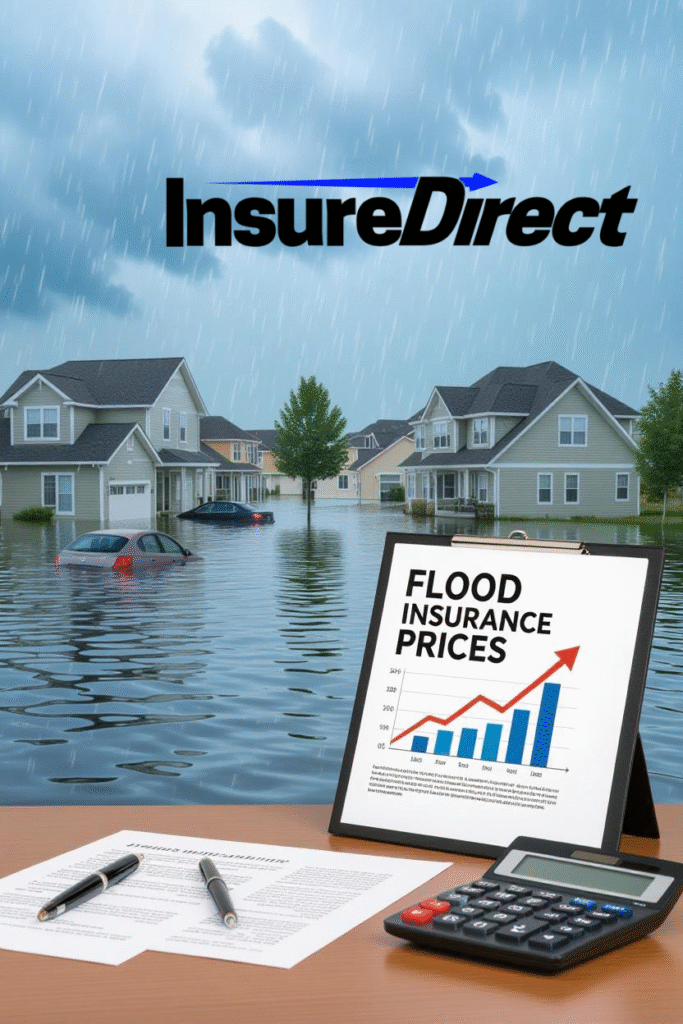
These days, climate change isn’t just a catchphrase anymore—it’s knocking at our doors, and sometimes, it feels like it’s kicking them in. The world’s weather is getting wild: storms that appear outta nowhere, rainfall that seems endless, and coastlines that vanish overnight. And all that chaos? It’s leaving a big dent in flood insurance prices.
🌧 The Increasing Risk
Floods used to come once in a while, mostly like every few decades or so. But now? Flash floods, coastal inundations—they happen like clockwork. Insurance companies aren’t pretending not to notice. They crunch the numbers, see the trend, and boom—your flood insurance premium bounces up like it’s had too much coffee.
The more often floods happen, the greater the risk becomes—and higher risk always equals higher rates. That’s not theory, that’s muddy math in action.
🏠 The Importance of Flood Insurance Now More Than Ever
Many homeowners still think, “I don’t live near a river, so I’m safe.” But surprise—over 25% of flood claims come from places outside the so-called high-risk zones, according to FEMA. And thanks to shifting weather patterns, even those “safe” areas are becoming not-so-safe.
Floods don’t need your permission. One heavy storm can dump a month’s rain in two days—and suddenly, you’re swimming in your living room. Without flood coverage, recovery costs can wash away your finances faster than the water itself.
So yeah, flood insurance isn’t just a luxury now. It’s more like a survival plan.
🌡 The Science Behind It: Warmer Air, Wetter World
Warmer air holds more moisture. Seems harmless, right? Except when all that moisture finally lets go, it rains harder, longer, and everywhere. That’s why “100-year floods” now come every few years.
And the sea? It’s rising like a slow but steady tide of trouble. Coastal areas are seeing sunny-day flooding—that’s when high tide alone pushes water into streets, no storm needed. Because of this, flood risk assessments are being rewritten, and insurance adjusters are scrambling to keep up.
🗺 FEMA’s Maps Are Falling Behind
FEMA’s flood maps used to make it easy—low, moderate, or high risk. But climate change? It doesn’t read maps; it redraws them.
Neighborhoods once labeled “safe” are now being reclassified. People who never needed flood insurance policies before are suddenly being told they must have one.
Insurance companies depend on these maps for pricing, but when the maps are outdated, everyone ends up confused—and underinsured.
In short, the floods are current, but the maps aren’t.
🏛 A Quick Look at the NFIP (National Flood Insurance Program)
The National Flood Insurance Program (NFIP) has been America’s flood safety net for decades. It provides flood coverage to renters, businesses, and homeowners—usually at rates cheaper than private markets.
But it’s struggling. As climate risks rise, so do claims. After disasters like Hurricane Harvey, Katrina, and Ida, NFIP paid out billions. And every year, as the seas rise, so do the payouts.
To stay solvent, NFIP rolled out a new pricing model: Risk Rating 2.0. It’s supposed to reflect actual, current risks instead of relying on outdated data. Sounds fair—until your premium doubles overnight.
💸 Risk Rating 2.0: Blessing or Burden?
FEMA now calculates premiums using advanced data—distance from water, property elevation, rainfall levels, rebuild cost, and more. It’s smart, sure. But not everyone’s thrilled.
For some coastal and low-lying homeowners, flood insurance prices are shooting up 20–40% yearly. Meanwhile, others in higher areas might even pay less.
The system aims for fairness, but middle-income families are feeling the squeeze. For many, flood insurance is turning from protection into a financial headache.
🏢 Private Flood Insurance Steps In
With NFIP under strain, private flood insurance companies are jumping in. They use different models, sometimes offering more flexible or personalized options.
Still, private insurers aren’t taking blind risks. They’re reading the same climate data—storms, rainfall intensity, sea rise—and often charge higher rates for high-risk zones. Because, let’s be honest, no company wants to gamble against nature.
🌪 When the Unpredictable Becomes Uninsurable
Insurance thrives on predictability. Companies depend on data to forecast risk. But climate change has basically thrown predictability out the window.
Every year brings “unprecedented” events. And when the unexpected keeps happening, insurers can’t keep prices stable. Some raise rates. Others pull out entirely.
States like Florida and Louisiana are already seeing insurers withdraw from flood-heavy regions. If trends continue, affordable flood insurance could become a thing of the past.
🏘 The Domino Effect: Real Estate, Mortgages & Communities
When insurance costs rise, property values fall. It’s a simple equation.
A home that once cost $250 to insure per month might soon cost $800. Buyers hesitate. Markets stall. And neighborhoods begin to hollow out as people move inland.
It’s not just about water—it’s about wealth, mortgages, and livelihoods. The ripple effect of rising flood insurance premiums could reshape entire coastal communities.
💰 Hidden Costs Nobody Mentions
Beyond premiums, there are other costs that creep in quietly. Bigger deductibles. Tighter claim rules. Smaller payouts.
Many insurers now ask for elevation certificates or floodproofing upgrades before renewing policies. And even small floods can cause big repair bills if coverage doesn’t apply.
In short? The fine print is getting finer—and more expensive.
⚡ Flood Insurance in the Age of Extremes
Extreme weather used to mean “rare.” Now it just means “annual.”
From flash floods in deserts to torrential rains up north, no region feels immune anymore. Climate models predict that by 2050, flood insurance rates could jump 50% nationwide. Some coastal spots might see even more.
Still, there’s hope. Insurers are starting to reward climate resilience—discounts for homes with raised foundations, sump pumps, and waterproof materials.
🧰 What Homeowners Can Actually Do
You can’t control the climate, but you can control your preparation.
1. Recheck Your Flood Zone
Even if FEMA says “low risk,” confirm it. Flood zones are shifting fast.
2. Compare Policies
Always shop between NFIP and private flood insurance providers. One may fit your budget better.
3. Invest in Flood Mitigation
Seal your basement, lift critical systems, and add water barriers. Many insurers offer small discounts for these upgrades.
4. Update Your Policy Annually
As your property value and weather data change, so should your coverage.
5. Adjust Your Deductible
Sometimes, a slightly higher deductible can significantly reduce your monthly cost.
6. Keep Proof Handy
Receipts, photos, and repair records make claim approvals faster when disaster strikes.
🏗 Governments Are Feeling the Pressure
Governments aren’t just watching; they’re paying, too.
Billions are spent each year on disaster recovery and flood relief. Some states are now debating climate risk surcharges or subsidies to help homeowners in vulnerable zones.
Others are focusing on prevention—building stronger levees, sea walls, and drainage systems. Still, adaptation takes money and time—both in short supply.
⚖️ Climate Justice & Insurance Inequality
Here’s the quiet part of the story: not everyone can afford to adapt.
Low-income families in high-risk zones face the worst of both worlds—higher risk, higher premiums. That gap is widening.
Without major reform, insurance inequality could become a new form of climate injustice—pricing millions out of homes they’ve lived in for generations.
🔮 The Future of Flood Insurance in a Warming World
The future’s unwritten—but it’s definitely wetter.
Experts predict that, by 2040, flood insurance premiums in some U.S. coastal regions might double or even triple. And inland cities won’t be safe either, thanks to stronger storms and saturated soil.
To adapt, insurers are experimenting with tech—AI flood modeling, satellite-based risk tracking, and climate-adaptive pricing systems.
Still, one thing’s sure: climate change is rewriting the insurance rulebook forever.
🌊 Conclusion: A Drip Turns Into a Wave
In the end, climate change and flood insurance are now joined at the hip. The disasters that used to happen once in a lifetime? They’re happening every year.
Insurance prices aren’t spiking for no reason—they’re reacting to a planet that’s getting wetter, stormier, and riskier.
For homeowners, insurers, and governments alike, adaptation isn’t optional anymore—it’s urgent.
Because ready or not, the flood is coming.
✅ SEO Keywords (Integrated Naturally)
flood insurance rates, FEMA flood maps, National Flood Insurance Program, Risk Rating 2.0, private flood insurance, climate change and insurance, flood coverage, rising sea levels insurance, affordable flood insurance, flood mitigation, flood risk assessment, flood insurance policy, flood insurance premiums, climate change impact on insurance, coastal flooding insurance.
InsureDirect.com
InsureDirect.com
Corporate Home Office
618 South Broad Street
Lansdale, Pennsylvania 19446
Email: contact@insuredirect.com
Phone: (800) 807-0762 ext. 602
Keep your home safe and secure with complete protection from InsureDirect—because your home deserves nothing less than the best.